<?xml version="1.0" encoding="UTF-8"?>
<feed xmlns="http://www.w3.org/2005/Atom">


      <title>Xefer</title>
      <link rel="alternate" type="text/html" href="http://www.xefer.com/" />
      <link rel="self" type="application/atom+xml" href="http://www.xefer.com/atom.xml" />
      <updated>2010-03-06T19:43:45Z</updated>
      <id>tag:www.xefer.com,2010:/2</id>    
      <generator uri="http://www.sixapart.com/movabletype/">Movable Type 3.2</generator>
     

    <entry>
      <title>New Maps of Pluto</title>
      <link rel="alternate" type="text/html" href="http://www.xefer.com/2010/03/pluto" />
      <id>tag:www.xefer.com,2010://2.243</id>
      <published>2010-03-06T14:32:53Z</published>
      <updated>2010-03-06T19:43:45Z</updated>
      <summary type="html"> The &quot;New Horizons&quot; probe recently passed the half-way point to Pluto - at least in terms of total distance flown. According to this simulation, it will be half-way between Pluto and the Sun on July 14th, and then half-way...</summary>
      <author>
          <name>Jeffrey</name>
          
      </author>
      
      <content type="html" xml:lang="en" xml:base="http://www.xefer.com/">
          <![CDATA[<p>
The "<a href="http://pluto.jhuapl.edu/news_center/news/20100225.php">New Horizons</a>" probe recently passed the half-way point to Pluto - at least in terms of total distance flown.  According to this <a href="http://www.dmuller.net/spaceflight/realtime.php?mission=newhorizons">simulation</a>, it will be half-way between Pluto and the Sun on July 14th, and then half-way in terms of total mission time on October 16th.   It's traveling around 59,000 km/hr relative to the Sun and still won't reach Pluto until July 14th, 2015 (at 07:59:00 GMT, so set your watches.)
</p>
<p>
<a href="http://www.boulder.swri.edu/~buie/">Marc Buie</a> of the <a href="http://www.boulder.swri.edu/">Southwest Research Institute</a> recently unveiled the highest resolution maps of Pluto yet produced:
</p>
<div class="figure">
  <img src="http://www.xefer.com/image/pluto.png"/>
  <p>Simulated true-color spherical projections of Pluto</p>
</div>
<p>This video shows a single complete rotation:</p>
<object type="application/x-shockwave-flash" style="width:550px; height:350px;" data="http://www.youtube.com/v/DrudH4IPpu4&autoplay=1&loop=1">
<param name="movie" value="http://www.youtube.com/v/DrudH4IPpu4&autoplay=1&loop=1" />
</object>
<p>
These maps and how they were produced are outlined in two recently published papers (<a href="http://www.boulder.swri.edu/~buie/biblio/pub072.html">one</a>, <a href="http://www.boulder.swri.edu/~buie/biblio/pub073.html">two</a>).   Some of the raw images used to produce the maps captured by the Hubble telescope are shown below.  The ones furthest to the left were obtained by the Faint Object Camera (FOC) in 1994; this camera is now out of service and has been replaced by the High Resolution Camera (HRC) which (despite its name) produces slightly lower resolution images (as can be seen below).  Faster computers have allowed a reanalysis of the original images and a comparison to be made with maps produced from the analysis of the newly acquired ones.
</p>
<div class="figure">
  <img src="http://www.xefer.com/image/plutoraw.png"/>
  <p>Raw Hubble images captured in 1994 (left-most column) and 2002/3</p>
</div> 
<p>
Similar processing techniques were applied to images taken in 1994.  Compared to the latest data, these show what Buie calls a "complex and dynamically interacting surface–atmosphere system."
</p>
<div class="figure">
  <img src="http://www.xefer.com/image/plutoatm.png"/>
  <p>Maps showing surface changes between 1994 (top) and 2002/3 (bottom)</p>
</div>
<p>
It has long been known that Pluto has a thin <a href="http://en.wikipedia.org/wiki/Pluto#Atmosphere">atmosphere</a> which gradually freezes and thaws as it moves closer to and further from the Sun over its 248-year orbit.    These maps though show direct evidence of this effect.
</p>]]>
      </content>
    </entry>


    <entry>
      <title>Ipswich, Massachusetts 1832</title>
      <link rel="alternate" type="text/html" href="http://www.xefer.com/2010/02/ipswich" />
      <id>tag:www.xefer.com,2010://2.242</id>
      <published>2010-02-17T18:08:47Z</published>
      <updated>2010-02-18T12:42:36Z</updated>
      <summary type="html"> A map of Ipswich Massachusetts by Philander Anderson. Ipswich, Massachusetts. 1832 Notice that the current Washington Street is called Gravel Street, which follows the path of the current Liberty Street to Lord Square. The current Mineral Street is called...</summary>
      <author>
          <name>Jeffrey</name>
          
      </author>
      
      <content type="html" xml:lang="en" xml:base="http://www.xefer.com/">
          <![CDATA[<p>
A map of Ipswich Massachusetts by Philander Anderson.
</p>
<div class="figure">
    <a href="http://i.imgur.com/KDKzr.jpg"><img src="http://www.xefer.com/image/ipswich.1832.s.jpg"/></a>
    <p>Ipswich, Massachusetts.  1832</p>
</div>
<p>
Notice that the current Washington Street is called Gravel Street, which follows the path of the current Liberty Street to Lord Square.  The current Mineral Street is called Back Street here.   Gravel Street takes its name from the two open gravel pits depicted on the map, one at the corner of Back Street and the other at the turn of what is now Liberty Street.
</p>
<div class="figure">
    <a href="http://i.imgur.com/KHPdM.jpg"><img src="http://www.xefer.com/image/ipswich.village.1832.s.jpg"/></a>
    <p>Closeup of the Ipswich Village inset</p>
</div>
<p>
A KMZ file viewable in Google Earth is of the village inset map is available <a href="http://xefer.com/ipswich.village.1832.kmz">here</a>.
</p>
<div class="figure">
   <a href="http://xefer.com/ipswich.village.1832.kmz">
    <img src="http://www.xefer.com/image/google.ipswich.jpg"/>
   </a>
   <p>Village inset map manipulated in Google Earth</p>
</div>
<p>
This map can also be seen directly in Google Maps using a normal browser <a href="http://maps.google.com/maps?f=q&source=s_q&hl=en&geocode=&q=http:%2F%2Fxefer.com%2Fipswich.village.1832.kmz&sll=37.0625,-95.677068&sspn=55.411532,79.013672&ie=UTF8&t=h&z=15">here</a>.
</p>]]>
      </content>
    </entry>


    <entry>
      <title>A Short History of the Word &quot;The&quot; (Part 2)</title>
      <link rel="alternate" type="text/html" href="http://www.xefer.com/2010/02/the" />
      <id>tag:www.xefer.com,2010://2.241</id>
      <published>2010-02-12T17:09:00Z</published>
      <updated>2010-02-28T22:13:06Z</updated>
      <summary type="html"> This continues some earlier notes I had made on the etymology of the word &quot;the&quot;. Old English is the earliest attested progenitor of modern English, so any earlier etymologies can only be done by comparing other related languages and...</summary>
      <author>
          <name>Jeffrey</name>
          
      </author>
      
      <content type="html" xml:lang="en" xml:base="http://www.xefer.com/">
          <![CDATA[<p>
This continues some <a href="http://www.xefer.com/2005/02/the">earlier notes</a> I had made on the etymology of the word "the".   
</p>
<p>
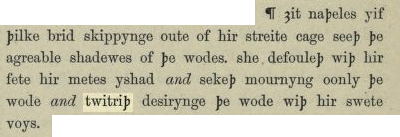
Old English is the earliest attested progenitor of modern English, so any earlier etymologies can only be done by comparing other related languages and reconstructing forms through the application of morphology rules.  English is a Germanic language related to German, Dutch, Norse and Icelandic.  The common ancestor of these languages is known as Proto-Germanic (PGmc)
</p>
<p>
Ringe (2006) has given the paradigm shown below.  Notice that it has the same s- in the masculine and feminine nominative singular, and þ- for all other forms, as in Old English.
</p>
	 <table class="scoped">    
	   <caption>Demonstrative Pronoun, “that”; Proto-Germanic:</caption>
       <thead>
        <tr>
         <th></th>
         <th scope="col">Masculine</th>
         <th scope="col">Feminine</th>
         <th scope="col">Neuter</th>
        </tr>
       </thead>
       <tbody>
        <tr><th scope="rowgroup">Singular</th></tr>
        <tr>
         <th scope="row">Nominative</td>
         <td>sa</td>
         <td>sō</td>
         <td>þat</td>
        </tr>
        <tr>
         <th scope="row">Accusative</td>
         <td>þanǭ</td>
         <td>þǭ</td>
         <td>þat</td>
        </tr>
        <tr>
         <th scope="row">Dative</td>
         <td>þammai</td>
         <td>þaizōi (?)</td>
         <td>þammai</td>
        </tr>
        <tr>
         <th scope="row">Genitive</th>
         <td>þas</td>
         <td>þaizōz</td>
         <td>þas</td>
        </tr>
        <tr>
         <th scope="row">Instrumental</th>
         <td>þana (?)</td>
         <td>þaizō</td>
         <td>þana (?)</td>
        </tr>
	  </tbody>
      <tbody>
        <tr><th scope="rowgroup">Plural</th></tr>
        <tr>
         <th scope="row">Nominative</th>
         <td>þai</td>
         <td>þōz</td>
         <td>þō</td>
        </tr>
		<tr>
         <th scope="row">Accusative</th>
         <td>þanz</td>
		 <td>þōz</td>
         <td>þō</td>
        </tr>
        <tr>
         <th scope="row">Dative</th>
         <td></td>
         <td>þaimaz</td>
         <td></td>
        </tr>
        <tr>
         <th scope="row">Genitive</th>
         <td></td>
         <td>þaizǭ</td>
         <td></td>
        </tr>
        <tr>
         <th scope="row">Instrumental</th>
         <td></td>
         <td>þaimiz</td>
         <td></td>
        </tr>
       </tbody>
      </table>
<p>
Things become more speculative reaching back to Proto-Indo-European. While there is general agreement that the stem of the demonstrative pronoun is so/to, the full inflection is more uncertain. The system given most often is that proposed by Beekes (1995). His is based on the theory put forward by Lane (1961). Given the many forms of the demonstratives among daughter languages, an inflection system based on the standard method of comparison would produce an unrealistic number of stems. Lane identified a fundamental mechanism within PIE of binding a number of standard particles to a basic stem.  The most familiar example of this general PIE mechanism is the development of the word "this": The OED gives the etymology as a Norse and West Germanic formation, produced by adding se, si (from Gothic, sai ‘see, behold’) to the simple demonstrative represented by "that", as shown by the early Old Norse runic forms, sá-si, sú-si, þat-si. Later the compound was felt as a single word and inflected at the end.
</p>
<p>
Beekes applied a similar approach, though with a different set of particles and updated with the application of <a href="http://en.wikipedia.org/wiki/Laryngeal_theory">laryngeal theory</a>.
</p>
<p>
Notice though that while PIE has a larger inflection system, like PGmc, it has the same s- in the male and female nominative and t- for the neuter and all other oblique forms. 
</p>
     <table class="scoped">
       <caption>Demonstrative Pronoun, “this, that”; Proto-Indo-European:</caption>
       <thead>
        <tr>
         <th></th>
         <th scope="col">Masculine</th>
         <th scope="col">Feminine</th>
         <th scope="col">Neuter</th>
        </tr>
       </thead>
       <tbody>
        <tr><th scope="rowgroup">Singular</th></tr>
        <tr>
         <th scope="row">Nominative</td>
         <td>so</td>
         <td>seh<sub>2</sub></td>
         <td>tod</td>
        </tr>
        <tr>
         <th scope="row">Accusative</th>
         <td>tom</td>
         <td>teh<sub>2</sub>m</td>
         <td>tod</td>
        </tr>
        <tr>
         <th scope="row">Dative</th>
         <td>tosmoi</td>
         <td>tesieh<sub>2</sub>ei</td>
         <td></td>
        </tr>
        <tr>
         <th scope="row">Genitive</tdh
         <td>(to)sio</td>
         <td>(t)eseh<sub>2</sub>s</td>
         <td></td>
        </tr>
        <tr>
         <th scope="row">Ablative</th>
         <td>tosmod</td>
         <td></td>
         <td></td>
        </tr>
        <tr>
         <th scope="row">Locative</th>
         <td>tosmi</td>
         <td>tesieh<sub>2</sub>i</td>
         <td></td>
        </tr>
        <tr>
         <th scope="row">Instrumental</th>
         <td>toi (?)</td>
         <td>toi (?)</td>
         <td></td>
        </tr>
        <tr><th scope="rowgroup">Plural</th></tr>
        <tr>
         <th scope="row"> Nominative</td>
         <td>toi</td>
         <td>seh<sub>2</sub>i (??)</td>
         <td>teh<sub>2</sub></td>
        </tr>
        <tr>
         <th scope="row">Accusative</td>
         <td>tons</td>
         <td>teh<sub>2</sub>ns</td>
         <td>teh<sub>2</sub></td>
        </tr>
        <tr>
         <th scope="row">Dative</th>
         <td>toimus</td>
         <td>teh<sub>2</sub>mus?</td>
         <td></td>
        </tr>
        <tr>
         <th scope="row">Genitive</th>
         <td>tesom (?)</td>
         <td>tesom (?)</td>
         <td></td>
        </tr>
        <tr>
         <th scope="row">Ablative</th>
         <td>toios (?)</td>
         <td></td>
         <td></td>
        </tr>
        <tr>
         <th scope="row">Locative</th>
         <td>toisu</td>
         <td>teh<sub>2</sub>su (?)</td>
         <td></td>
        </tr>
        <tr>
         <th scope="row">Instrumental</th>
         <td>toibʰi</td>
         <td>teh<sub>2</sub>bʰi (?)</td>
         <td></td>
        </tr>
       </tbody>
      </table>
<p>
Attempts have been made to find relationships between PIE and other language families.  Greenberg (2002) has proposed "<a href="http://en.wikipedia.org/wiki/Eurasiatic">Eurasiatic</a>" that groups PIE with languages as diverse as Korean, Japanese and Eskimo-Aleut.
</p>
<p>
Interestingly there is similarity between the PIE demonstrative root and the constructed ancestors of other members of this proposed group. E.g.:
</p>
<table class="scoped"> 
  <caption>Demonstrative Pronoun stems, “this,that”; Yukaghir-Uralic vs. PIE:</caption>
  <thead>
    <tr>
         <th scope="col">Yukaghir</th>
         <th scope="col">Uralic</th>
         <th scope="col">Indo-European</th>
        </tr>
	  </thead>
	  <tbody>
       <tr>
        <td>
         <b>tiŋ</b> (Tundra),<br> <b>tuŋ</b> (Kolyma) ‘this’;<br>
         <b>taŋ</b> ‘that’
        </td>
        <td>
         *<b>tä</b> ‘this’ (eg. Finnish <i>tä-mä</i>);<br>
         *<b>to</b> ‘that’ (eg. Estonian <i>too</i>)
        </td>
        <td>
         *<b>to-</b> ‘this, that’
        </td>
       </tr>
      </tbody>
</table>
<p>
Greenberg gives a general demonstrative stem of *tV, that is, “t” followed by some vowel.
</p>
<table class="scoped" width="100%">
  <caption>Demonstrative Pronoun stem, Eurasiatic:</caption>
  <tbody>
    <tr><td> *tV </td></tr> </tbody>
</table>
<p>
Once etymologies get this deep, the standard linguistic tools begin to break down.  The best that could probably be done would be to perform mathematical analysis which assigns a level of correlation and generates possible forms.
</p>
<p>
If this reconstructed stem is accurate, that "t" at the beginning of our word "the" goes back nearly 15,000 years.
</p>
<h4>Notes</h4>
<p>
[1]  Ringe, Donald A., <a href="http://amazon.com/o/asin/0199552290/10030-20">From Proto-Indo-European to Proto-Germanic</a>. 2006, p. 288-289.
<br/>
[2] Mallory J. P.; Adams, Douglas Q., <a href="http://amazon.com/o/asin/0199287910/10030-20">The Oxford Introduction to Proto-Indo-European and the Proto-Indo-European World</a>. 2006, p. 417-418.
<br/>
[3] Lehmann, Winfred P., <a href="http://www.amazon.com/o/asin/0415138507">Theoretical Bases of Indo-European Linguistics</a>. 1996, p. 158-159.
<br/>
[4] Beekes, Robert S. P., <a href="http://amazon.com/o/asin/1556195052/10030-20">Comparative Indo-European Linguistics</a>. 1995, p. 201-204.
<br/>
[5] Lane, George S., On the Formation of the Indo-European Demonstrative. Language, Vol. 37, No. 4 (Oct. - Dec., 1961), pp. 469-475.
<br/>
[6] Greenberg, Joseph H., <a href="http://amazon.com/o/asin//0804738122/10030-20">Indo-European and its Closest Relatives</a>: The Eurasiatic Language Family, Vol 1. 2000, p. 94-101.
</p>
]]>
      </content>
    </entry>


    <entry>
      <title>Men of the North</title>
      <link rel="alternate" type="text/html" href="http://www.xefer.com/iuncturae/2010/01/240" />
      <id>tag:www.xefer.com,2010:/iuncturae//3.240</id>
      <published>2010-01-31T21:51:28Z</published>
      <updated>2010-02-03T20:25:04Z</updated>
      <summary type="html">Colby Cosh has an intriguing piece in the National Post that mentions forthcoming evidence from Pat Sutherland which will strengthen her claim that the Nanook site on Baffin Island is a Norse Settlement. Sutherland&apos;s original paper was dismantled by University...</summary>
      <author>
          <name>Jeffrey</name>
          
      </author>
      
      <content type="html" xml:lang="en" xml:base="http://www.xefer.com/iuncturae/">
          <![CDATA[Colby Cosh has an intriguing <a href="http://www.nationalpost.com/opinion/columnists/story.html?id=c724e542-ed94-4ced-83e9-12ed234f67e3">piece</a> in the National Post that mentions forthcoming evidence from Pat Sutherland which will strengthen her claim that the <a href="http://www.canada.com/story_print.html?id=1632232&sponsor=">Nanook</a> site on Baffin Island is a Norse Settlement.
<p>
Sutherland's original paper was dismantled by University of Waterloo anthropologist <a href="http://anthropology.uwaterloo.ca/park.html">Robert Park</a> in an article in Antiquity magazine entitled, "<a href="http://findarticles.com/p/articles/mi_hb3284/is_315_82/ai_n29422005/">Contact between the Norse Vikings and the Dorset culture in Arctic Canada</a>". 
</p>
<p>
One line of Park's attack points to pre-870 A.D. carbon dating of supposed Norse material from the Nanook site.  That is the accepted date of first Norse settlement of Iceland and documented in the famous <a href="http://en.wikipedia.org/wiki/Landn%C3%A1mab%C3%B3k">Landnámabók</a>.  This would impose a firm time line on any contact further West.
</p>
<p>
A recent <a href="http://www.icelandreview.com/icelandreview/daily_news/?cat_id=16539&ew_0_a_id=351553">article</a> in The Iceland Review though describes the analysis of physicist Páll Theódórsson which pushes the settlement of Iceland back 200 years. While his work has (as far as I can determine) yet to be thoroughly critiqued by others, it may weaken one aspect of Park's arguments.  
</p>
<p>
It will be interesting to see how these arguments play out.
</p>]]>
      </content>
    </entry>


    <entry>
      <title>Distribution of Generic Watercourse Terms</title>
      <link rel="alternate" type="text/html" href="http://www.xefer.com/2010/01/naming" />
      <id>tag:www.xefer.com,2010://2.239</id>
      <published>2010-01-18T20:28:11Z</published>
      <updated>2010-01-21T14:15:12Z</updated>
      <summary type="html"> Below are some interesting maps showing how generic terms for watercourses are distributed in the Northeastern United States from a 1955 paper by Wilbur Zelinsky.1 The term river is universal throughout the examined area, so only terms applied to...</summary>
      <author>
          <name>Jeffrey</name>
          
      </author>
      
      <content type="html" xml:lang="en" xml:base="http://www.xefer.com/">
          <![CDATA[<p>
Below are some interesting maps showing how generic terms for watercourses are distributed in the Northeastern United States from a 1955 paper by <a id="zelinsky-r" href="http://en.wikipedia.org/wiki/Wilbur_Zelinsky">Wilbur Zelinsky</a>.<sup><a href="#zelinsky">1</a></sup>  The term  <i>river</i> is universal throughout the examined area, so only terms applied to small- and mid-sized streams were examined.
</p>
<p>
The term <i>creek</i> was typically used in England only for coastal estuaries of which there are of course many along the Atlantic seaboard of America; however, it's American usage as a generic term for fresh water streams occurs most commonly west of the Hudson River:
</p>
<div class="figure">
<img alt="creek.png" src="http://www.xefer.com/image/creek.png"/>
</div>
<p>
Zelinsky discusses the theory that because of the broader coastal plain in this area, coastal watercourses named as creeks actually flowed from much farther inland.  The term was applied more generally as the population expanded to the interior. 
</p>
<div class="figure">
<img alt="brook.png" src="http://www.xefer.com/image/brook.png"/>
</div>
<p>
The term <i>brook</i> is coincident with the New England cultural area and it's expansion directly westward.  It's English meaning as a stream with a fast flow rate was more applicable to the hillier coastal topography.
</p>
<div class="figure">
<img alt="run.png" src="http://www.xefer.com/image/run.png"/>
</div>
<p>
The term <i>run</i> is dialectical to northern England and Scotland and may have become common in the Appalachian area because of the influx of Scottish and Irish immigrants.
</p>
<div class="figure">
<img alt="branch.png" src="http://www.xefer.com/image/branch.png"/>
</div>
<div class="figure">
<img alt="fork.png" src="http://www.xefer.com/image/fork.png"/>
</div>
<p>
Both <i>branch</i> and <i>fork</i> were used exclusively to describe tributaries in England, but were applied to general streams in America.  Although the terms were used widely, no pattern can be discern from their application other than the fact that they are entirely absent from the earliest areas of settlement, indicating a later adoption.
</p>
<div class="figure">
<img alt="stream.png" src="http://www.xefer.com/image/stream.png"/>
</div>
<p>
The generic term <i>stream</i> is only common in the most northerly reaches (and most lately settled) areas of New England, and also very sporadically south to Virginia.
</p>
<p class="center">
<span>&middot;</span>
</p>
<p>
<sup id="zelinsky">1</sup> <i>Some Problems in the Distribution of Generic Terms in the Place-Names of the Northeastern
United States</i> by <a href="http://en.wikipedia.org/wiki/Wilbur_Zelinsky">Wilbur Zelinsky</a>. Annals of the Association of American Geographers, Vol. 45, No. 4 (Dec., 1955), pp. 319-349.  <a href="#zelinsky-r">back</a>.
</p>]]>
      </content>
    </entry>


    <entry>
      <title>Book Review</title>
      <link rel="alternate" type="text/html" href="http://www.xefer.com/iuncturae/2009/12/238" />
      <id>tag:www.xefer.com,2009:/iuncturae//3.238</id>
      <published>2009-12-14T23:26:16Z</published>
      <updated>2009-12-14T23:30:42Z</updated>
      <summary type="html">A hilariously humorless review of Magnus Mills&apos; &quot;The Maintenance of Headway&quot; from The Socialist Worker....</summary>
      <author>
          <name>Jeffrey</name>
          
      </author>
      
      <content type="html" xml:lang="en" xml:base="http://www.xefer.com/iuncturae/">
          <![CDATA[A hilariously humorless review of Magnus Mills' "<a href="http://www.amazon.co.uk/Maintenance-Headway-Magnus-Mills/dp/1408800357/10300-20">The Maintenance of Headway</a>" from <a href="http://www.socialistworker.co.uk/art.php?id=19754">The Socialist Worker</a>.]]>
      </content>
    </entry>


    <entry>
      <title>Old Burlington Mall</title>
      <link rel="alternate" type="text/html" href="http://www.xefer.com/2009/06/Burlington" />
      <id>tag:www.xefer.com,2009://2.237</id>
      <published>2009-06-09T23:14:17Z</published>
      <updated>2009-06-24T19:28:12Z</updated>
      <summary type="html"> Off in a corner of a parking lot of the Executive Office Park in Burlington, Massachusetts there is a small waterfall where a little stream emerges out from under Mall Road and tumbles into what, for all intents and...</summary>
      <author>
          <name>Jeffrey</name>
          
      </author>
      
      <content type="html" xml:lang="en" xml:base="http://www.xefer.com/">
          <![CDATA[<p>
Off in a corner of a parking lot of the Executive Office Park in Burlington, Massachusetts there is a small 
 waterfall where a little stream emerges out from under Mall Road and tumbles into what, for all intents and
purposes, is a drainage ditch.<sup>1</sup>  It's a bit remarkable that in the otherwise dehumanizing surroundings
of a typical suburban industrial park there remains this small remnant of relatively untouched landscape&mdash;
such as it is.
</p>
<div class="figure">
  <img src="/image/mall2009.jpg" alt="Burlington Mall"/>
  <p>Site of the Burlington Mall; Burlington, MA.</p>
</div>
<p>
My father talks about hunting in the area  as a kid, of course long before the Burlington Mall and Route 128 were
put in, when this area was what he thought of as the middle of nowhere.  Burlington is currently a modestly
sized suburb of Boston with a population of around 23,000, but back before it was tied into the national highway
system, it hovered around 1000.
</p>
<div class="figure">
  <img src="/image/mall1946.jpg" alt="Burlington 1946"/>
  <p>Site of the Burlington Mall; <a href="http://docs.unh.edu/towns/BurlingtonMassachusettsMapList.htm">Burlington, MA</a>, 1946 prior to the construction of Route 128.</p>
</div>
<p>
Looking at some old USGS maps of the area shows just how much things of changed.   The <a href="http://en.wikipedia.org/wiki/Vine_Brook">Vine Brook</a> has been
completely covered by the mall itself - and emerges out on the other side of the Vine Brook Plaza - another 
bit of development named in typical fashion after the very thing it has helped destroy...  The waterfall is part
of the Long Meadow Brook&mdash;which has more or less maintained its original course, although straightened along
the edge of the parking lot before passing back under the road where it eventually joins with the Vine Brook
before merging with the Shawsheen River.
</p>
<div class="figure">
  <img src="/image/mall1875.jpg" alt=Burlington 1875"/>
  <p>Site of the Burlington Mall; <a href="http://menotomymaps.com/prop_maps_ma.asp">Burlington, MA</a>, c. 1870.</p>
</div>
<p>
When 128 and the Mall were put in, a number of streets where reconfigured, including the location of the old
South School at the junction of Blanchard Road and Lexington Street. 
</p>
<div class="figure">
  <img src="/image/southsc.jpg" alt="South School"/>
  <p>South School in Burlington, MA.  Now a parking lot outside of Sears.</p>
</div>
<p>
 The only picture shows the old building in a verdant, rural setting&mdash;basically the antithesis of what is now there: the parking lot of the Sears Home and Garden Center.
</p>
<p>
<sup>1</sup> Here is a picture of the falls itself.  The flow is unusually high here because of recent rains.
</p>
<div class="figure">
  <img src="/image/falls.jpg" alt="Long Meadow Brook Falls"/>
  <p>Long Meadow Brook Falls.</p>
</div>
<p>A file, viewable in Google Earth, showing the maps above laid out over the modern terrain is available <a href="/burlington.kml">here</a>.
<p>A map showing the precise location of the falls is <a href="http://maps.google.com/maps/ms?ie=UTF8&amp;hl=en&amp;msa=0&amp;ll=42.485661,-71.208245&amp;spn=0.001586,0.002411&amp;t=h&amp;z=19&msid=117113601719281846558.00046d1b688cf860e853e">here</a>.   In the satellite view, the arc of the brook can be easily made out even though it is obscured by vegetation.</p>
<p>A short video clip that captures some of the majesty of the falls is <a href="http://www.youtube.com/watch?v=vYv6tLturU4">here</a>.</p>]]>
      </content>
    </entry>


    <entry>
      <title>Early Norse Contact on Baffin Island</title>
      <link rel="alternate" type="text/html" href="http://www.xefer.com/iuncturae/2009/05/236" />
      <id>tag:www.xefer.com,2009:/iuncturae//3.236</id>
      <published>2009-05-28T13:19:27Z</published>
      <updated>2009-05-28T13:33:35Z</updated>
      <summary type="html"> &quot;At three sites on Baffin Island, which the Norse called &apos;Helluland&apos; or &apos;land of stone slabs,&apos; and another in northern Labrador, the researchers have documented dozens of suspected Norse artifacts such as Scandinavian-style spun yarn, distinctively notched and decorated...</summary>
      <author>
          <name>Jeffrey</name>
          
      </author>
      
      <content type="html" xml:lang="en" xml:base="http://www.xefer.com/iuncturae/">
          <![CDATA[<p>
"At three sites on Baffin Island, which the Norse called 'Helluland' or 'land of stone slabs,' and another in northern Labrador, the researchers have documented dozens of suspected Norse artifacts such as Scandinavian-style spun yarn, distinctively notched and decorated wood objects and whetstones for sharpening knives and axes."
</p>
<p>
The evidence looks fairly compelling that there was at least some level of contact, which seems reasonable given that they knew the area well enough to give it a name.   Interestingly there is evidence of rat droppings which implies Viking ships at Baffin Island as opposed to contact possibly established in the other direction.
</p>
<p>
An early <a href="http://www.nunatsiaq.com/archives/2008/809/80912/news/nunavut/80912_1516.html">article</a> states that radio carbon dating on some spun yarn gives a date several hundred years prior to Viking contact, which suggests earlier contact with Europeans than previously thought.
</p>]]>
      </content>
    </entry>


    <entry>
      <title>Earliest References to &quot;Ipswich&quot;</title>
      <link rel="alternate" type="text/html" href="http://www.xefer.com/2009/05/gepeswich" />
      <id>tag:www.xefer.com,2009://2.235</id>
      <published>2009-05-24T19:38:21Z</published>
      <updated>2009-05-26T01:26:46Z</updated>
      <summary type="html"> These are the earliest written references to the city of Ipswich: 942 A.D.: Will of Theodred, Bishop of London. Sawyer 1529. See: Charta Anglosaxonicae, p. 293 line 9. BISHOP ÐEODRED In nomine domini nostri Ihusu Christi! ... And ic...</summary>
      <author>
          <name>Jeffrey</name>
          
      </author>
      
      <content type="html" xml:lang="en" xml:base="http://www.xefer.com/">
          <![CDATA[<p>
These are the earliest written references to the city of  Ipswich:
</p>
<p>
<b>942 A.D.</b>:  Will of Theodred, Bishop of London.  <a href="http://www.esawyer.org.uk/content/charter/1526.html">Sawyer 1529</a>. See: <a href="http://books.google.com/books?id=mRALAAAAYAAJ">Charta Anglosaxonicae</A>, <a href="http://books.google.com/books?id=mRALAAAAYAAJ&printsec=frontcover#PPA293,M1">p. 293</a> line 9.
</p>
<blockquote>
<p class="center">BISHOP ÐEODRED</p>
<p>In nomine domini nostri Ihusu Christi!</p>
<p>...</p>
<p>And ic an ðat lond at Waldringfeld Osgote mine sustres sune and min hage ðat ic binnin <b>Gypeswich</b> bouhte.</p>
</blockquote>
<p>
<p class="center"><b>☩</b></p>
<b>975 A.D.</b>: Coins minted in Ipswich bearing the image of <a href="http://en.wikipedia.org/wiki/Edgar_of_England">Eadgar</a> and the location of the mint.<sup>1</sup>
</p>
<p>
front:  <b>☩</b> EADGAR . REX . ANGLOR .  (Eadgar, king of the English)<br/>
back:  <b>☩</b> LIFINGE . MO . <b>GIPSǷIC</b> . (Lifinge, moneyer at Gipswic)
</p>
<p>
<div class="figure">
<img src="/image/gipcoin.jpg" alt="Coin bearing the name of the mint at Gipeswic"/>
<p>Hammered silver penny.  "ON <b>GIPESWIC</b>" written on reverse.</p>
</div>
</p>
<p>
<sup>1</sup> Golding, C. <a href="">The Coinage of Suffolk</a>. 1868. <a href="http://books.google.com/books?id=wv8HAAAAQAAJ&printsec=titlepage#PPA8,M1">p. 8</a>.
</p>
<p>
<p class="center"><b>☩</b></p>
<b>991 A.D.</b>: <a href="http://books.google.com/books?id=f8B4NAl2r48C">The Anglo-Saxon Chronicle</a>, <a href="http://en.wikipedia.org/wiki/Peterborough_Chronicle">Peterborough Manuscript</a> (<a href="http://asc.jebbo.co.uk/e/e-L.html">E</a>).
</p>
<blockquote>
<p>
 Her wæs <b>Gypeswic</b> gehergod, &#8266; æfter þam swiðe raðe wæs Brihtnoð ealdorman ofslægen æt Mældune. &#8266; on þam geare man gerædde þet man geald ærest gafol Deniscan mannum for þam mycclan brogan þe hi worhtan be þam særiman; þet wæs ærest .x. þusend punda. Þæne ræd gerædde Siric arcebiscop. 
</p>
</blockquote>
<blockquote>
<p>
Here Ipswich was raided, and very soon after that Ealdorman Byrhtnoth was killed at Maldon; and in that year it was first decided tax be paid to the Danish men because of the great terror which they wrought along the sea coast.  That was at first 10 thousand pounds.  Archbishop Sigeric decided on the decision.
</p>
</blockquote>]]>
      </content>
    </entry>


    <entry>
      <title>An Etymology of &quot;Ipswich&quot; </title>
      <link rel="alternate" type="text/html" href="http://www.xefer.com/2009/05/ipswich" />
      <id>tag:www.xefer.com,2009://2.234</id>
      <published>2009-05-13T19:27:31Z</published>
      <updated>2009-05-20T12:36:03Z</updated>
      <summary type="html"><![CDATA[ Ipswich as Gepeswiz from the Domesday Book, 1086 The name of the town of Ipswich in Massachusetts&mdash;originally called Agawam&mdash;comes directly from the city of Ipswich in Suffolk England. While some second-order sources claim that the name was chosen because...]]></summary>
      <author>
          <name>Jeffrey</name>
          
      </author>
      
      <content type="html" xml:lang="en" xml:base="http://www.xefer.com/">
          <![CDATA[<div class="figure">
  <img src="/image/gepeswizb.jpg" alt="Gepeswiz"/>
  <p>Ipswich as <i>Gepeswiz</i> from the Domesday Book, 1086</p>
</div>
<p>
The name of the town of <a href="http://en.wikipedia.org/wiki/Ipswich,_Massachusetts">Ipswich</a> in Massachusetts&mdash;originally called <i>Agawam</i>&mdash;comes directly from the city of <a href="http://en.wikipedia.org/wiki/Ipswich">Ipswich</a> in Suffolk England.  While some second-order sources claim that the name was chosen because that is where many of its early citizens were from, there is no actual evidence of this.
</p>
<div class="figure">
  <img src="/image/speed.jpg" alt="John Speed, Ipswitche"/>
  <p>Inset of <i>Ipswiche</i> from John Speed's <i>Suffolke</i>, 1610</p>
</div>
<p>
The official records of the <a href="http://en.wikipedia.org/wiki/Massachusetts_Bay_Colony">Massachusetts Bay Colony</a> for August 5th, 1634 make no mention of that supposed fact, stating tersely:
</p>
<blockquote>
<p>
It is ordered, that Aggawam shalbe called Ipswitch.<sup id="ipswich-1"><a href="#fn-ipswich-1">1</a></sup>
</p>
</blockquote>
<p>
Then governor <a href="http://en.wikipedia.org/wiki/John_Winthrop">John Winthrop</a>, who had sent his son to establish the town in 1633, noted in his journal entry for August 4th, 1634:
</p>
<blockquote>
<p>
At the court, the new town at Agawam was named Ipswich, in acknowledgment of the great honor and kindness done to our people which took shipping there, etc.; and a day of thanksgiving appointed, a fortnight after, for the prosperous arrival of the others, etc.<sup><a href="fn-ipswich-2">2</a></sup>
</p>
</blockquote>
<p>
Ipswich is a truncated version of its original name, <i>Gippeswick</i>, though that spelling is a relatively modern standardization of a name that took many forms (as was usual for the period.)  It was spelled alternatively as <i>Gipewiz</i>, <i>Gepeswiz</i>, or <i>Gypeswiz</i> in the <a href="http://en.wikipedia.org/wiki/Domesday_book">Domesday Book</a> commissioned by <a href="http://en.wikipedia.org/wiki/William_I_of_England">William the Conqueror</a> and completed in 1086.<sup id="ipswich-3"><a href="#fn-ipswich-3">3</a></sup><sup>,</sup><sup id="ipswich-4"><a href="#fn-ipswich-4">4</a></sup>
</p>
<div class="figure">
  <img src="/image/gepeswizs.jpg" alt="Gepeswic"/>
  <p>"The <a href="http://en.wikipedia.org/wiki/Hundred_(administrative_division)">half-hundred</a> of Ipswich" from the Domesday Book, 1086</p>
</div>
<div class="figure">
  <img src="/image/gepeswizl.jpg" alt="Gepeswic"/>
  <p>"The <a href="http://en.wikipedia.org/wiki/Hundred_(administrative_division)">half-hundred</a> of Ipswich"  from the Domesday Book, 1086</p>
</div>
<p>
There are two main theories on the origin of <i>Gippeswick</i>, both of which ultimately derive from an Anglo-Saxon personal name.
</p>
<h4>Indirect Adoption</h4>
<p>
The first is that Gippeswick took its name from the <a href="http://en.wikipedia.org/wiki/River_Gipping">River Gipping</a> concatenated with the Anglo-Saxon (Old English) word <i>wic</i>, meaning dwelling-place or abode.<sup id="ipswich-5"><a href="#fn-ipswich-5">5</a></sup> <i>Wic</i> is derived from the Latin <i>vicus</i>, for village, which was borrowed as <i>*wik</i> by Proto-Germanic, the unattested precursor to Anglo-Saxon. When applied to a town name it generally meant a trading place or port, which is what Gippeswick had become soon after its founding in the early 7th century.<sup id="ipswich-6"><a href="#fn-ipswich-6">6</a></sup>
</p>
<p>
River Gipping takes its name directly from the village of <a href="http://en.wikipedia.org/wiki/Gipping">Gipping</a> near its headwaters.<sup id="ipswich-7"><a href="#fn-ipswich-7">7</a></sup>  Gipping or Gypping is a concatenation of <i>Gyppa</i>, an Anglo-Saxon personal name and the suffix <i>-ingas</i>, meaning "the people of".  Who this person "Gyppa" might have been is lost to history, but it was perhaps the name of a Anglo-Saxon clan leader, someone who established a colony as part of the initial wave of Northern Germanic immigration in the wake of Rome's abandonment of Britannia in the 5th century.<sup id="ipswich-8"><a href="#fn-ipswich-8">8</a></sup>   In any case, it was someone of enough import that his descendants or followers maintained an identity through the name. The area became know as the land of "Gyppa-ingas" - "followers of Gyppa".<sup id="ipswich-9"><a href="#fn-ipswich-9">9</a></sup> 
</p>
<h4>Direct Adoption</h4>
<p>
The second is that Gippeswick took the name of this putative Gyppa directly.  Gyppa-wick would be the trading center of a man named Gyppa.<sup id="ipswich-10"><a href="#fn-ipswich-10">10</a></sup> Gipping would have taken it's name more indirectly from Gyppa at some later period. This process would actually follow the ideas of Dodgson who put forth the theory that place names ending in <i>-ingas</i> are associated with the colonization of areas more distant (both physically and temporally) from those of the initial immigration.<sup id="ipswich-11"><a href="#fn-ipswich-11">11</a></sup> 
</p>
<p>
In either case, fifteen-hundred years later, a shadow of this man's name remains as part of a town across an ocean in a land he could hardly have imagined.
</p>
<div class="figure">
  <a href="/image/ety.png">
  <img src="/image/etys.jpg" alt="An etymology of Ipswich"/>
  </a>
  <p>An <a href="/image/ety.png">Etymology</a> of <i>Ipswich</i></p>
</div>
</p>
<p>
While all etymologies see Ipswich ultimately deriving its name from the Gipping River, earlier ideas for the derivation differ:
</p>
<p>
E.g.,  <i>geap</i>, an Old English word meaning "to wander" <sup id="ipswich-12"><a href="#fn-ipswich-12">12</a></sup>;  or from the
Gaelic word <i>caep</i>, <i>cip</i>, congate with the Latin <i>caput</i>, or head, source. The Gipping being
the head of the river Orwell <sup id="ipswich-13"><a href="#fn-ipswich-13">13</a></sup>.
</p>
<h4>Notes</h4>
<p>
<sup id="fn-ipswich-1"><a href="#ipswich-1">1</a></sup> <a href="http://books.google.com/books?id=ypYMAAAAYAAJ">Records of the Governor and Company of the Massachusetts Bay in New England</a>.  August 5th, 1633.
 </p>
<p>
<sup id="fn-ipswich-2"><a href="#ipswich-2">2</a></sup> <a href="http://books.google.com/books?id=Iwo6FnGALocC">The Journal of John Winthrop</a>, 1630-1649.
 </p>
<p>
<sup id="fn-ipswich-3"><a href="#ipswich-3">3</a></sup> <a href="http://www.data-archive.ac.uk/findingdata/snDescription.asp?sn=5694">Electronic Edition of Domesday Book</a>: Translation, Databases and Scholarly Commentary, 1086.  UK Data Archive. 2007.
 </p>
<p>
<sup id="fn-ipswich-4"><a href="#ipswich-4">4</a></sup> <a href="http://www.nationalarchives.gov.uk/documentsonline/domesday.asp">Domesday Book</a>.  UK National Archives. 2006.
</p>
<p>
<sup id="fn-ipswich-5"><a href="#ipswich-5">5</a></sup> Russo, Daniel G. <a href="http://books.google.com/books?id=NQcTY6ARhd8C">Town origins and development in early England</a>, c.400-950 A.D. 1998, p. 161.
</p>
<p>
<sup id="fn-ipswich-6"><a href="#ipswich-6">6</a></sup> <i>Ibid</i>, p. 142.
 </p>
<p>
<sup id="fn-ipswich-7"><a href="#ipswich-7">7</a></sup> Laflin, S., <a href="http://www.namestudies.me.uk/Ingas.pdf">Do -ingas place-names occur in pairs?</a> English Place-Name Society Journal, 35 (2003), pp. 31–40.
</p>
<p>
<sup id="fn-ipswich-8"><a href="#ipswich-8">8</a></sup> Stenton, Frank M.; Parsons, Doris M. (ed.) <a href="http://books.google.com/books?id=v1hMck3rF-MC">Preparatory to Anglo-Saxon England</a>: being the collected papers of Frank Merry Stenton. 1970.
</p>
<p>
<sup id="fn-ipswich-9"><a href="#ipswich-9">9</a></sup> Carver, M. O. H. <a href="http://books.google.com/books?id=58MNMG2-e4oC">The Age of Sutton Hoo</a>: The Seventh Century in North-Western Europe. 1994, p. 54.
 </p>
<p>
<sup id="fn-ipswich-10"><a href="#ipswich-10">10</a></sup> Mills, A. D. <a href="http://www.amazon.co.uk/o/asin/0198527586">A Dictionary of British Place-Names</a>. 2003.
 </p>
<p>
<sup id="fn-ipswich-11"><a href="#ipswich-11">11</a></sup> Dodgson, J. M. <a href="http://ads.ahds.ac.uk/catalogue/adsdata/arch-769-1/ahds/dissemination/pdf/vol10/10_001_029.pdf">The Significance of the Distribution of the English Place-Name in-ingas,-inga in South-east England</a>. 1966.
 </p>
<p>
<sup id="fn-ipswich-12"><a href="#ipswich-12">12</a></sup> Charnock, Richard S. <a href="http://books.google.com/books?id=r2YDAAAAQAAJ">Local Etymology</a>: A Derivative Dictionary of Geographical Names. 1859.
 </p>
<p>
<sup id="fn-ipswich-13"><a href="#ipswich-13">13</a></sup> White, Charles H.; Tymms, S. (ed.) <a href="http://books.google.com/books?id=aAUIAAAAQAAJ">The East Anglian</a>; or, Notes and queries on subjects connected with the counties of Suffolk, Cambridge, Essex, and Norfolk, 1864.
 </p>]]>
      </content>
    </entry>


    <entry>
      <title>Anton Chigurh&apos;s Quarter</title>
      <link rel="alternate" type="text/html" href="http://www.xefer.com/2009/04/chigurh" />
      <id>tag:www.xefer.com,2009://2.233</id>
      <published>2009-04-18T22:13:37Z</published>
      <updated>2009-04-25T17:48:29Z</updated>
      <summary type="html"> In Cormac McCarthy&apos;s book (and in the Coen brother&apos;s adaption of) &quot;No Country for Old Men&quot;, there is an infamous scene where the assassin, Anton Chigurh, subjects a gas-station owner to a trial where his life hangs in the...</summary>
      <author>
          <name>Jeffrey</name>
          
      </author>
      
      <content type="html" xml:lang="en" xml:base="http://www.xefer.com/">
          <![CDATA[<p>
In Cormac McCarthy's book (and in the Coen brother's adaption of) "<a href="http://amazon.com/o/asin/0375406778">No Country for Old Men</a>", there is an infamous scene where the assassin, Anton Chigurh, subjects a gas-station owner to a trial where his life hangs in the outcome of a coin toss.  The innocent owner is at first unaware of the purpose of Chigurh's demand to "call it", but the morbidity of the situation slowly starts to dawn on him.  (I won't repeat the entire oft-quoted exchange; you can read it <a href="http://www.imdb.com/title/tt0477348/quotes#qt0466818">here</a>.)
</p>
<blockquote>
<p>
"You know what date is on this coin?"<br/>
"No."<br/>
"1958. It's been traveling twenty-two years to get here. And now it's here.<br/>
</p>
</blockquote>
<p>
Is there any meaning to the date, 1958?  At first it just seemed random, but it struck me that perhaps this is not the case.  In 1965 the <a href="http://en.wikipedia.org/wiki/Coinage_Act_of_1965">Coin Act</a> changed the make-up of U.S. coins so that dimes, quarters and half-dollars were no longer 90% silver, but where instead cladded nickel and zinc.  <a href="http://en.wikipedia.org/wiki/Gresham%27s_Law">Gresham's Law</a> states that bad money quickly pushes good money out of circulation as people tend to horde the coins with the higher intrinsic value.  This is exactly what happened in the U.S.; silver coins quickly began to disappear from circulation until by 1980, when the <a href="http://en.wikipedia.org/wiki/Hunt_brothers">Hunt Brothers</a>' attempt to corner the silver market pushed the price of silver to $50/oz., it was rare to find one.
</p>
<div class="figure">
<img src="/image/chigurh.jpg" alt="Anton Chigurh"/>
<p>What's the most you ever lost in a coin toss?</p>
</div>
<p>
So what was Chigurh doing with a silver coin in his pocket in 1980?   There's really no hint, but I doubt McCarthy wasn't aware of the oddity of a silver coin being in someone's possession at that late date.  My guess is that the enigmatic Chigurh is meant to have a collection of these coins in his pocket for just this purpose.  He seems to know the date of the coin without even looking at it.  It has a significance known to only him which compounds for the reader the mystery behind his dark convictions.
</p>


]]>
      </content>
    </entry>


    <entry>
      <title>Dropkick Murphy&apos;s at Bellows Farm</title>
      <link rel="alternate" type="text/html" href="http://www.xefer.com/2009/03/bellowsfarm" />
      <id>tag:www.xefer.com,2009://2.232</id>
      <published>2009-03-27T20:52:37Z</published>
      <updated>2009-07-02T20:08:39Z</updated>
      <summary type="html"> While the Dropkick Murphys are a fine group, I&apos;ve always been more interested in the name of the band itself. Members have always told that they took the name from a supposed detox center, owned and operated by a...</summary>
      <author>
          <name>Jeffrey</name>
          
      </author>
      
      <content type="html" xml:lang="en" xml:base="http://www.xefer.com/">
          <![CDATA[<p>
While the <a href="http://en.wikipedia.org/wiki/Dropkick_murphys">Dropkick Murphys</a> are a fine group, I've always been more interested in the name of the band itself.   Members have <a href="http://www.thefreelibrary.com/Dropkick+Murphys-a0142205455">always
told</a> that they took the name from a supposed detox center, owned and 
operated by a former wrestler by the name of John "Dropkick" Murphy.  The Boston 
Herald columnist Howie Carr has salted his columns with mentions of the place for years&mdash; 
generally in reference to the Kennedys&mdash;well before the existence of the band of
the same name.  E.g.:
</p>
<blockquote>
<p>
"And how would you like to be Joe Kennedy? Here's your uncle, looking more 
like an escapee from <b>Dropkick Murphy's</b> every day, and he says he's going to 
run again in 1994? "
</p>
<p>
- Howie Carr. Boston Herald. October 28, 1991
</p>
</blockquote>
<p>
So while the name of the place is fairly well-known (around Boston anyway) its
actual existence has remained somewhat more legendary.  Several places mention that its
official name was "Bellows Farm" located in Acton, Massachusetts.   There is now a road 
called "Bellows Farm Road" in Acton on or near the original property. 
</p>
<div class="figure">
<a href="http://maps.google.com/maps/ms?ie=UTF8&hl=en&amp;msa=0&amp;ll=42.500516,-71.408472&amp;spn=0.01427,0.034719&amp;t=p&amp;z=15&amp;msid=117113601719281846558.0004661f4a1bbced2089a">
<img src="/image/acton.png" alt="Map of part of Acton"/>
</a>
<p>Bellows Farm Road near Neshoba Brook in Acton, Massachusetts</p>
</div>
<p>
While I couldn't find any specifics or pictures of the facility, several mentions
of it show that this must be the place.
</p>
<p>
 A Massachusetts court case from 1973 (2 years after the facility closed)
mentions Murphy:
</p>
<blockquote>
<p>
"This is a bill in equity under G. L. c. 231A, seeking a declaration whether certain amendments to the 
zoning by-law of the town of Acton (town) apply to a parcel of land (locus) owned by the plaintiffs 
<b>Bellows Farms</b>, Inc. and <b>John E. Murphy</b> and on which the plaintiff Donald P. O'Grady has contracted 
to build 402 apartment units. The defendants are the town, its building inspector and the members 
of its board of selectmen."
</p>
<p>
<a href="http://masscases.com/cases/sjc/364/364mass253.html">BELLOWS FARMS, INC. & OTHERS vs. BUILDING INSPECTOR OF ACTON & OTHERS</a>. April 4, 1973 - November 7, 1973.
</p>
</blockquote>
<p>
This land is along the Nashoba Brook in Acton which is mentioned in an article on fishing in Massachusetts
from the New York Times:
</p>
<blockquote>
<p>
We visited a spot in Boston (Jamaica Pond); then he gave me an hour on <b>Neshoba Brook</b> (on a stretch open to the 
public and owned by <b>Dropick Murphy</b>, a former wrestler) where I caught two brook trout.
</p>
<p>
"Wood Field and Stream" New York Times. May 9, 1968.
</p>
</blockquote>
<p>
Finally there is this small advertisement for the facility a year after it opened (the only one I could find anywhere)
</p>
<div class="figure">
<img src="/image/bellowad.png" alt="Bellows Farm Ad"/>
<p>The New York Times. July 5, 1942.</p>
</div>
<p>
$25 per week works out to be about $325 per week in 2009 dollars, which isn't exactly cheap.  Legends of the place being some last stop for end of the line winos might be a bit misplaced.  
</p>
<p>
<b>Dropkick Murphy</b> <i>was</i> an actual wrestler.  Here is small clip from back when The New York Times
actually used to report on professional wrestling:
</p>
<div class="figure">
<img src="/image/murphy.png" alt="Dropkick Murphy Ad"/>
<p>The New York Times. Jun 26, 1938.</p>
</div>]]>
      </content>
    </entry>


    <entry>
      <title>Metropole</title>
      <link rel="alternate" type="text/html" href="http://www.xefer.com/2009/03/metropole" />
      <id>tag:www.xefer.com,2009://2.231</id>
      <published>2009-03-07T20:20:54Z</published>
      <updated>2009-03-11T16:34:14Z</updated>
      <summary type="html"> &quot;Kafkaesque&quot; is perhaps our most overused eponymous adjective, but in the case of Hungarian writer Ferenc Karinthy&apos;s brilliant Metropole, there is simply no more fitting term to employ. It&apos;s amazing that this book, written in 1970, has only recently...</summary>
      <author>
          <name>Jeffrey</name>
          
      </author>
      
      <content type="html" xml:lang="en" xml:base="http://www.xefer.com/">
          <![CDATA[<div class="basicimg">
  <a href="http://www.amazon.co.uk/o/asin/1846590345"><img src=
    "http://images.amazon.com/images/P/1846590345.02._SCMZZZZZZZ_.jpg" alt="Metropole cover"
   title="Metropole" /></a>
</div>
<p>
"Kafkaesque" is perhaps our most overused eponymous adjective, but in the case of Hungarian writer <a href="http://en.wikipedia.org/wiki/Ferenc_Karinthy">Ferenc Karinthy</a>'s brilliant <a href="http://www.amazon.co.uk/o/asin/1846590345">Metropole</a>, there is simply no more fitting term to employ.  It's amazing that this book, written in 1970, has only recently been translated into English for the first time.
</p>
<p>
Budai, a linguist on a trip to Helsinki for a conference, mistakenly lands in an unknown, crushingly-overcrowded city where people speak an utterly incomprehensible language.  Signs, symbols, art, food, religion, all bare a resemblance to a vaguely pan-European culture, but the populous appears to be a mixture of races from all over the world.    His frustrations slowly morph into panic then resignation as his inability to communicate drains away his assurance and dignity in the claustrophobic atmosphere amongst the indifferent, if not outright hostile multitudes.
</p>
<p>
Eventually he begins to wonder if everyone else around him is just as trapped as he is.  It's hard not to see the novel as an allegory of life in the Eastern Bloc.  The original title of the book is "Epépé" which is one of the ever-shifting names Budai applies to the single person he manages to maintain the thinnest tendril of a relationship with.   The fact that her name shifts seemingly unselfconsciously on Biadu's part suggests his unknowing abidance at the cusp of some dreamworld.  It's perhaps telling that the Hungarian title focuses more on this one human relationship than the dehumanizing metropolis of the English translation.  It hints at the ultimate hope of salvation which is perhaps the most un-Kafkaesque aspect of the entire book.
</p>]]>
      </content>
    </entry>


    <entry>
      <title>New Book from Magnus Mills in August</title>
      <link rel="alternate" type="text/html" href="http://www.xefer.com/2009/02/mills" />
      <id>tag:www.xefer.com,2009://2.230</id>
      <published>2009-02-26T23:25:26Z</published>
      <updated>2009-04-28T14:17:44Z</updated>
      <summary type="html"> Magnus Mills the Booker Prize-nominated author who was famously a bus driver before his first book was published, is apparently still plying that trade. He has a rather innocuous commentary in The Independent which while typically clever and all,...</summary>
      <author>
          <name>Jeffrey</name>
          
      </author>
      
      <content type="html" xml:lang="en" xml:base="http://www.xefer.com/">
          <![CDATA[     <div class="basicimg">
      <a href="http://www.amazon.co.uk/o/asin/1408800357"><img src=
      "http://images-eu.amazon.com/images/P/1408800357.02._SCMZZZZZZZ_.jpg" alt="The Maintenance of Headway cover"
      title="The Maintenance of Headway" /></a>
     </div>
</p>
<a href="http://en.wikipedia.org/wiki/Magnus_Mills">Magnus Mills</a> the Booker Prize-nominated author who was famously a bus driver before his first book was published, is apparently still plying that trade.  He has a rather innocuous <a href="http://www.independent.co.uk/opinion/commentators/magnus-mills-spare-a-thought-for-us-bus-drivers-1607194.html">commentary</a> in The Independent which while typically clever and all, is more remarkable for its low-key announcement of his new book due to be published in August:  <a href="http://www.amazon.co.uk/o/asin/1408800357">The Maintenance of Headway</a>.
</p>
<p>The snippet from the book is classic Mills:</p>
<blockquote>
<p>
'It's a matter of procedure,' I explained. 'Strictly for the record. You don't get sacked from this job unless you did what Thompson did.'<br/>'What did he do then?'<br/>'We never mention it.'
</p>
</blockquote>
<p>I can't wait.</p>]]>
      </content>
    </entry>


    <entry>
      <title>81-year-old father of Zacharias Kunuk, director of &quot;Atanarjuat: The Fast Runner&quot; found alive after 28 days</title>
      <link rel="alternate" type="text/html" href="http://www.xefer.com/iuncturae/2009/01/229" />
      <id>tag:www.xefer.com,2009:/iuncturae//3.229</id>
      <published>2009-01-25T14:33:27Z</published>
      <updated>2009-01-25T14:51:50Z</updated>
      <summary type="html">Okay, this story is over a year old, but I missed it at the time. Enoki Kunuk headed off to hunt caribou but got his snowmobile stuck by the thaw 100 kilometers from home. The military called of the search...</summary>
      <author>
          <name>Jeffrey</name>
          
      </author>
      
      <content type="html" xml:lang="en" xml:base="http://www.xefer.com/iuncturae/">
          <![CDATA[<p>Okay, this story is over a year old, but I missed it at the time.</p>
<p><a href="http://en.wikipedia.org/wiki/Enoki_Kunuk">Enoki Kunuk</a> headed off to hunt caribou but got his snowmobile stuck by the thaw 100 kilometers from home.   The military called of the search for him after more than two weeks, but he was discovered alive and well 10 days later having kept himself fed and sheltered.  Not bad for 81.
</p>]]>
      </content>
    </entry>


    <entry>
      <title>Boston Then and Now</title>
      <link rel="alternate" type="text/html" href="http://www.xefer.com/2008/09/boston" />
      <id>tag:www.xefer.com,2008://2.228</id>
      <published>2008-09-05T02:13:47Z</published>
      <updated>2009-04-28T14:23:31Z</updated>
      <summary type="html"> Boston Skyline, September 21, 1942 The above is an early color photo of Boston taken from across the Charles River in Cambridge. It is part of the Charles W. Cushman Photograph Collection hosted at the University of Indiana. Same...</summary>
      <author>
          <name>Jeffrey</name>
          
      </author>
      
      <content type="html" xml:lang="en" xml:base="http://www.xefer.com/">
          <![CDATA[<div class="figure">
<a href="http://www.flickr.com/photos/xefer/2829550256/">
<img src="/image/boston1942s.jpg" alt="Boston from Cambridge in 1942"/>
</a>
<p>Boston Skyline, September 21, 1942</p>
</div>
<p>
The above is an early color photo of Boston taken from across the Charles River in Cambridge.  It is part of the <a href="http://webapp1.dlib.indiana.edu/cushman/">Charles W. Cushman Photograph Collection</a> hosted at the University of Indiana.
</p>
<div class="figure">
<a href="http://www.flickr.com/photos/xefer/2828713343/">
<img src="/image/boston2008s.jpg" alt="Boston from Cambridge in 2008"/>
</a>
<p>Same Location, August 30, 2008</p>
</div>
<p>
The above is the same location taken just last week.   Things have changed quite a bit in the last 60 years.  In the top photo, the tallest building on the left is the Suffolk County Courthouse; next to it is the Custom House Tower.
</p>]]>
      </content>
    </entry>


    <entry>
      <title>Auyuittuq: &apos;The Land that Never Melts&apos; is Melting</title>
      <link rel="alternate" type="text/html" href="http://www.xefer.com/2008/08/auyuittuq" />
      <id>tag:www.xefer.com,2008://2.227</id>
      <published>2008-08-07T13:19:08Z</published>
      <updated>2009-04-28T14:18:32Z</updated>
      <summary type="html"> The title of this entry comes from a quote in a CBC News article yesterday describing the on-going flooding problems in Auyuittuq National Park on Baffin Island. Parks Canada officials say they have never seen anything like this before...</summary>
      <author>
          <name>Jeffrey</name>
          
      </author>
      
      <content type="html" xml:lang="en" xml:base="http://www.xefer.com/">
          <![CDATA[<p>
The title of this entry comes from a quote in a CBC News <a href="http://www.cbc.ca/technology/story/2008/08/06/park-pang.html">article</a> yesterday describing the on-going flooding problems in <a href="http://en.wikipedia.org/wiki/Auyuittuq">Auyuittuq National Park</a> on <a href="http://en.wikipedia.org/wiki/Baffin_Island">Baffin Island</a>.
</p>
<blockquote>
<p>
Parks Canada officials say they have never seen anything like this before in Auyuittuq.
"Auyuittuq means 'land that never melts,' but of course now it's melting," Pauline Scott, a spokeswoman for Parks Canada's Nunavut field unit, told CBC News on Tuesday.
</p>
</blockquote>
<p>
Auyuittuq is one of the most beautiful places in the world, and it has meant a lot to me since my <a href="http://www.xefer.com/2008/05/baffin">travels</a> there.  Individual weather anomalies are of course impossible to tie to overall climate change, but it's hard not to see this as part of a larger, more tragic trend.
</p>
<p>
The picture accompanying the article shows the Weasel River undermining the moraine field that holds back Crater Lake, which I've pointed out in the following map:
</p>
<div class="figure">
<a href="http://maps.google.com/maps/ms?ie=UTF8&hl=en&t=h&msa=0&msid=117113601719281846558.000453dd82264657d589c&ll=66.590311,-65.166779&spn=0.457769,1.333466&z=10">
<img alt="craterlake.jpg" src="http://www.xefer.com/image/craterlake.jpg" />
</a>
<p>Google Maps satellite image of Crater Lake, Akshayuk Pass in Auyuittuq National Park, Nunavut, Canada</p>
</div>
<p>
The referenced article also connected the flooding here with that which occurred this June in <a href="http://en.wikipedia.org/wiki/Pangnirtung%2C_Nunavut">Pangnirtung</a> which I had mentioned <a href="http://www.xefer.com/iuncturae/2008/08/225">recently</a>. 
</p>]]>
      </content>
    </entry>


    <entry>
      <title>Envisat Image of Foxe Basin</title>
      <link rel="alternate" type="text/html" href="http://www.xefer.com/iuncturae/2008/08/226" />
      <id>tag:www.xefer.com,2008:/iuncturae//3.226</id>
      <published>2008-08-07T00:57:58Z</published>
      <updated>2009-04-28T14:19:25Z</updated>
      <summary type="html"> A beautiful image taken by the ESA&apos;s Envisat satellite. On the right (East) is Baffin Island showing Nettilling Lake which drains via the Koukdjuak River into Foxe Basin. Nettilling Lake is the largest lake on an island in the...</summary>
      <author>
          <name>Jeffrey</name>
          
      </author>
      
      <content type="html" xml:lang="en" xml:base="http://www.xefer.com/iuncturae/">
          <![CDATA[<p>
A beautiful image taken by the ESA's <a href="http://en.wikipedia.org/wiki/Envisat">Envisat</a> satellite.   On the right (East) is Baffin Island showing Nettilling Lake which drains via the Koukdjuak River into Foxe  Basin.
</p>
<div class="figure">
<img src="/image/foxe.jpg" alt="foxe basin"/>
</div>
<p>
Nettilling Lake is the largest lake on an island in the world.  The two islands in the picture are <a href="http://en.wikipedia.org/wiki/Foley_Island">Prince Charles Island</a> (the largest on the left) and <a href="http://en.wikipedia.org/wiki/Air_Force_Island">Air Force Island</a>  which along with <a href="http://en.wikipedia.org/wiki/Foley_Island">Foley Island</a> (not pictured) are the last large landmasses discovered in North America.
</p>
<p>
They were only found to be separate islands from pictures taken by aerial overflights by the Canadian Air Force in 1948.
</p>
<p>
Oddly enough these islands are close by another group, the Spicer Islands, rediscovered in 1946.
</p>
<blockquote>
<p>
A Canadian air-borne expedition to the Arctic has rediscovered the Spicer Islands and a number of hitherto unknown islands under the eaves of the continent.
The Spicer Islands were discovered in 1897 by Captain Spicer of New Bedford. They were duly marked on maps and charts but had never since been found and there was doubt of their existence.
</p>
</blockquote>
<p>New  York Times, September 10, 1946</p>]]>
      </content>
    </entry>


    <entry>
      <title>Flooding Forces the Evacuation of Auyuittuq National Park</title>
      <link rel="alternate" type="text/html" href="http://www.xefer.com/iuncturae/2008/08/225" />
      <id>tag:www.xefer.com,2008:/iuncturae//3.225</id>
      <published>2008-08-06T01:20:27Z</published>
      <updated>2008-08-06T01:28:34Z</updated>
      <summary type="html">Unusually warm temperatures coupled with heavy rains caused such extensive flooding in Auyuittuq that 21 hikers had to be evacuated from the park. This follows recent flooding in Pangnirtung that wiped out several bridges. There the flooding bore through the...</summary>
      <author>
          <name>Jeffrey</name>
          
      </author>
      
      <content type="html" xml:lang="en" xml:base="http://www.xefer.com/iuncturae/">
          <![CDATA[Unusually warm temperatures coupled with heavy rains caused such extensive flooding in <a href="http://en.wikipedia.org/wiki/Auyuittuq">Auyuittuq</a> that 21 hikers had to be evacuated from the park.  This follows <a href="http://www.nunatsiaq.com/archives/2008/806/80620/news/nunavut/80620_1297.html">recent flooding</a> in <a href="http://en.wikipedia.org/wiki/Pangnirtung,_Nunavut">Pangnirtung</a> that wiped out several bridges.   There the flooding bore through the permafrost right down to the bedrock and there was some concern that the entire town could be undermined.]]>
      </content>
    </entry>


    <entry>
      <title>A Guide to Black Flag&apos;s &quot;TV Party&quot;</title>
      <link rel="alternate" type="text/html" href="http://www.xefer.com/2008/08/tvparty" />
      <id>tag:www.xefer.com,2008://2.224</id>
      <published>2008-08-05T00:08:06Z</published>
      <updated>2008-08-05T13:32:41Z</updated>
      <summary type="html"> Of all the television shows mentioned in the two versions of Black Flag&apos;s song &quot;TV Party&quot;, only one, Saturday Night Live, remains on the air in its original form. The other long-running show, Monday Night Football, changed networks in...</summary>
      <author>
          <name>Jeffrey</name>
          
      </author>
      
      <content type="html" xml:lang="en" xml:base="http://www.xefer.com/">
          <![CDATA[<p>
Of all the television shows mentioned in the two versions of <a href="http://en.wikipedia.org/wiki/Black_Flag_(band)">Black Flag</a>'s song "TV Party", only one, Saturday Night Live, remains on the air in its original form.  The other long-running show, Monday Night Football, changed networks in 2006, and while it is much the same show, technically the chain was broken.  Other than those, the last hold-out was "Dallas" which went off the air in 1991.
</p>
<p> Video: <a href="http://www.youtube.com/watch?v=hFF7jzVfSB0">TV Party</a></p>
<p>
The original version of the song, was released as part of their masterwork <a href="http://en.wikipedia.org/wiki/Damaged_(Black_Flag_album)">Damaged</a>.  This was followed up some months later by a new version recorded for the <a href="http://en.wikipedia.org/wiki/TV_Party_(EP)">TV Party</a> EP.  Together they called out the following shows:
</p>
<ul>
<li><a href="http://en.wikipedia.org/wiki/That%27s_Incredible!">That's Incredible!</a></li>
<li><a href="http://en.wikipedia.org/wiki/Hill_Street_Blues">Hill Street Blues</a></li>
<li><a href="http://en.wikipedia.org/wiki/Dallas_(TV_series)">Dallas</a></li> 
<li><a href="http://en.wikipedia.org/wiki/Fridays">Fridays</a></li>
<li><a href="http://en.wikipedia.org/wiki/Quincy%2C_M.E.">Quincy</a></li>
<li><a href="http://en.wikipedia.org/wiki/Saturday_Night_Live">Saturday Night Live</a></li>
<li><a href="http://en.wikipedia.org/wiki/Monday_Night_Football">Monday Night Football</a></li>
<li><a href="http://en.wikipedia.org/wiki/The_Jeffersons">The Jeffersons</a> (LP version only)</li>
<li><a href="http://en.wikipedia.org/wiki/Vega$">Vega$</a>  (LP version only)</li>
<li><a href="http://en.wikipedia.org/wiki/Dynasty">Dynasty</a> (EP version only)</li>
</ul>
<p>
When the song was re-recorded for the EP, two shows were dropped, "The Jeffersons" and "Vega$" and replaced with "Dynasty".  "Vega$" had already been canceled at the time of the original recording which perhaps had something to do with it.  "Fridays" was gone before the EP was released.
</p>
<div class="figure">
  <a href="/tvparty"><img src="/image/tvparty.png" alt="tvparty"/></a>
  <p>Click on the diagram for more detail</p>
</div>
<p>
The diagram shown above was made using <a href="http://simile.mit.edu/timeline/">Timeline</a> part of MIT's <a href="http://simile.mit.edu/">SIMILE</a> project.  It is perhaps the definitive overview of TV Party and its place in television history.   I'm sure if this song was recast for this decade, blogs and such would probably be the focus, the irony of which is not lost on me.
</p>]]>
      </content>
    </entry>
  
</feed>