<?xml version="1.0" encoding="UTF-8"?>
<feed version="0.3" xmlns="http://purl.org/atom/ns#" xmlns:dc="http://purl.org/dc/elements/1.1/" xml:lang="en">
<title>iuncturae xeferarum</title>
<link rel="alternate" type="text/html" href="http://www.xefer.com/iuncturae/" />
<modified>2008-08-08T18:13:55Z</modified>
<tagline></tagline>
<id>tag:www.xefer.com,2008:/iuncturae/3</id>
<generator url="http://www.movabletype.org/" version="3.2">Movable Type</generator>
<copyright>Copyright (c) 2008, Jeffrey</copyright>
<entry>
<title>Envisat Image of Foxe Basin</title>
<link rel="alternate" type="text/html" href="http://www.xefer.com/iuncturae/2008/08/226" />
<modified>2008-08-08T18:13:55Z</modified>
<issued>2008-08-07T00:57:58Z</issued>
<id>tag:www.xefer.com,2008:/iuncturae/3.226</id>
<created>2008-08-07T00:57:58Z</created>
<summary type="text/plain"> A beautiful image taken by the ESA&apos;s Envisat satellite. On the right (East) is Baffin Island showing Nettilling Lake which drains via the Koukdjuak River into Foxe Basin. Nettilling Lake is the largest lake on an island in the...</summary>
<author>
<name>Jeffrey</name>


</author>

<content type="text/html" mode="escaped" xml:lang="en" xml:base="http://www.xefer.com/iuncturae/">
<![CDATA[<p>
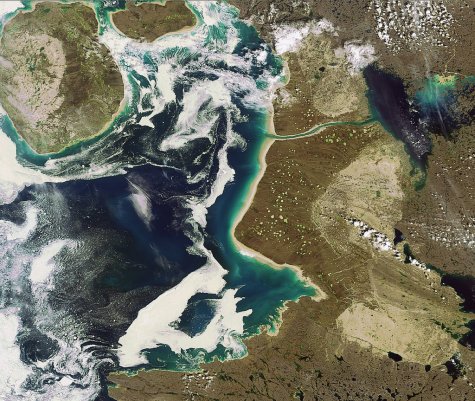
A beautiful image taken by the ESA's <a href="http://en.wikipedia.org/wiki/Envisat">Envisat</a> satellite.   On the right (East) is Baffin Island showing Nettilling Lake which drains via the Koukdjuak River into Foxe  Basin.
</p>
<div class="figure">
<img src="/image/foxe.jpg" alt="foxe basin"/>
</div>
<p>
Nettilling Lake is the largest lake on an island in the world.  The two islands in the picture are <a href="http://en.wikipedia.org/wiki/Foley_Island">Prince Charles Island</a> (the largest on the left) and <a href="http://en.wikipedia.org/wiki/Air_Force_Island">Air Force Island</a>  which along with <a href="http://en.wikipedia.org/wiki/Foley_Island">Foley Island</a> (not pictured) are the last large landmasses discovered in North America.
</p>
<p>
They were only found to be separate islands from pictures taken by aerial overflights by the Canadian Air Force in 1948.
</p>
<p>
Oddly enough these islands are close by another group, the Spicer Islands, rediscovered in 1946.
</p>
<blockquote>
A Canadian air-borne expedition to the Arctic has rediscovered the Spicer Islands and a number of hitherto unknown islands under the eaves of the continent.
The Spicer Islands were discovered in 1897 by Captain Spicer of New Bedford. They were duly marked on maps and charts but had never since been found and there was doubt of their existence.
</blockquote>
<p>New  York Times, September 10, 1946</p>]]>

</content>
</entry>
<entry>
<title>Flooding Forces the Evacuation of Auyuittuq National Park</title>
<link rel="alternate" type="text/html" href="http://www.xefer.com/iuncturae/2008/08/225" />
<modified>2008-08-06T01:28:34Z</modified>
<issued>2008-08-06T01:20:27Z</issued>
<id>tag:www.xefer.com,2008:/iuncturae/3.225</id>
<created>2008-08-06T01:20:27Z</created>
<summary type="text/plain">Unusually warm temperatures coupled with heavy rains caused such extensive flooding in Auyuittuq that 21 hikers had to be evacuated from the park. This follows recent flooding in Pangnirtung that wiped out several bridges. There the flooding bore through the...</summary>
<author>
<name>Jeffrey</name>


</author>

<content type="text/html" mode="escaped" xml:lang="en" xml:base="http://www.xefer.com/iuncturae/">
<![CDATA[Unusually warm temperatures coupled with heavy rains caused such extensive flooding in <a href="http://en.wikipedia.org/wiki/Auyuittuq">Auyuittuq</a> that 21 hikers had to be evacuated from the park.  This follows <a href="http://www.nunatsiaq.com/archives/2008/806/80620/news/nunavut/80620_1297.html">recent flooding</a> in <a href="http://en.wikipedia.org/wiki/Pangnirtung,_Nunavut">Pangnirtung</a> that wiped out several bridges.   There the flooding bore through the permafrost right down to the bedrock and there was some concern that the entire town could be undermined.]]>

</content>
</entry>
<entry>
<title>Antikythera Mechanism</title>
<link rel="alternate" type="text/html" href="http://www.xefer.com/iuncturae/2008/07/223" />
<modified>2008-08-01T02:26:52Z</modified>
<issued>2008-08-01T02:18:24Z</issued>
<id>tag:www.xefer.com,2008:/iuncturae/3.223</id>
<created>2008-08-01T02:18:24Z</created>
<summary type="text/plain"> The above links to the original letter in Nature describing the new discoveries concerning the Antikythera Mechanism. There is also 40 pages of detailed supplementary material (10 times longer than the article itself!) Among all the pieces written about...</summary>
<author>
<name>Jeffrey</name>


</author>

<content type="text/html" mode="escaped" xml:lang="en" xml:base="http://www.xefer.com/iuncturae/">
<![CDATA[<p>
The above links to the original letter in Nature describing the new discoveries concerning the <a href="http://en.wikipedia.org/wiki/Antikythera_mechanism">Antikythera Mechanism</a>.   There is also 40 pages of detailed <a href="http://www.nature.com/nature/journal/v454/n7204/extref/nature07130-s1.pdf">supplementary material</a> (10 times longer than the article itself!)
</p>
<p>
Among all the <a href="http://blog.wired.com/wiredscience/2008/07/worlds-first-co.html">pieces</a> <a href="http://www.nytimes.com/2008/07/31/science/31computer.html?ex=1375243200&en=4594326ce2f92ec7&ei=5124&partner=permalink&exprod=permalink">written</a> about it I couldn't find any that referenced the actual article itself so I thought I'd put one here...
</p>]]>

</content>
</entry>
<entry>
<title>Phoenix Lander Location</title>
<link rel="alternate" type="text/html" href="http://www.xefer.com/iuncturae/2008/07/222" />
<modified>2008-07-26T13:03:42Z</modified>
<issued>2008-07-25T20:18:15Z</issued>
<id>tag:www.xefer.com,2008:/iuncturae/3.222</id>
<created>2008-07-25T20:18:15Z</created>
<summary type="text/plain"> Some quick notes on the location of the Phoenix Mars Lander: It is located at 68.218830°N 234.250778°E (or 68.218830°N 125.749222°W). Using the same prime meridian as Earth this would project onto a spot about 120 miles northwest of Great...</summary>
<author>
<name>Jeffrey</name>


</author>

<content type="text/html" mode="escaped" xml:lang="en" xml:base="http://www.xefer.com/iuncturae/">
<![CDATA[<p>
Some quick notes on the location of the Phoenix Mars Lander:
</p>
<p>
It is located at 68.218830°N 234.250778°E (or 68.218830°N 125.749222°W).   Using the same prime meridian as Earth this would project onto a spot about 120 miles northwest of Great Bear Lake in the Northwest Territories of Canada.
</p>
<p>
The Martian Arctic Circle is at 64.81°N, which puts the lander around 3.4° North of the circle.  Since Earth's axial tilt is somewhat less extreme than Mars' (23.439281° vs 25.19°), Earth's Arctic Circle is at 66.56083°N.
</p>
<p>
Keeping the longitude the same, but projecting the position 3.4° North of Earth's Arctic Circle places the landing spot at the equivalent of a location in Franklin Bay in the Arctic Ocean off the coast of the Northwest Territories.  
</p>
<p>
See the map <a href="http://maps.google.com/maps/ms?ie=UTF8&hl=en&msa=0&msid=117113601719281846558.000452de45dad2332584a&ll=69.96966,-125.749222&spn=26.320436,83.232422&t=h&z=4">here</a>.
</p>]]>

</content>
</entry>
<entry>
<title>Above the Martian Arctic Circle</title>
<link rel="alternate" type="text/html" href="http://www.xefer.com/iuncturae/2008/07/221" />
<modified>2008-07-25T11:45:05Z</modified>
<issued>2008-07-25T01:55:03Z</issued>
<id>tag:www.xefer.com,2008:/iuncturae/3.221</id>
<created>2008-07-25T01:55:03Z</created>
<summary type="text/plain"> The Phoenix Mars Lander took a series of shots of the sun hanging low over the Martian North Pole. With the lander being above the Arctic Circle and it being Summer in the Northern Hemisphere, the montage shows how...</summary>
<author>
<name>Jeffrey</name>


</author>

<content type="text/html" mode="escaped" xml:lang="en" xml:base="http://www.xefer.com/iuncturae/">
<![CDATA[<div class="figure">
<a href="http://phoenix.lpl.arizona.edu/images/gallery/sm_15233.jpg">
<img src="\image\marsarctic.jpg" alt="Martian Arctic Sun"/>
</a>
</div>
<p>
The <a href="http://phoenix.lpl.arizona.edu/">Phoenix Mars Lander</a> took a series of shots of the sun hanging low over the Martian North Pole.   With the lander being above the Arctic Circle and it being Summer in the Northern Hemisphere, the montage shows how the sun never dips below the horizon.  Beautiful.
</p>
<p>
More details at the image's <a href="http://phoenix.lpl.arizona.edu/images.php?gID=15233&cID=172">page</a>.    The entire gallery of images is <a href="http://phoenix.lpl.arizona.edu/imageCategories_press.php">here</a>.
</p>]]>

</content>
</entry>
<entry>
<title>Polar Bear Shot in Iceland</title>
<link rel="alternate" type="text/html" href="http://www.xefer.com/iuncturae/2008/06/220" />
<modified>2008-06-20T02:07:52Z</modified>
<issued>2008-06-20T01:28:09Z</issued>
<id>tag:www.xefer.com,2008:/iuncturae/3.220</id>
<created>2008-06-20T01:28:09Z</created>
<summary type="text/plain"> For the second time since April a polar bear has made its way the 300km from Greenland. Even though it most likely drifted part of the way on an ice flow, in both cases they must have swum tremendous...</summary>
<author>
<name>Jeffrey</name>


</author>

<content type="text/html" mode="escaped" xml:lang="en" xml:base="http://www.xefer.com/iuncturae/">
<![CDATA[<p>
For the second time since April a polar bear has made its way the 300km from Greenland.  Even though it most likely drifted part of the way on an ice flow, in both cases they must have swum tremendous distances over the open Atlantic.
</p>
<p>
Polar bears are not native to Iceland. Prior to these two incidences there hadn't been a bear seen in Iceland in 20 years.  More details <a href="http://www.spiegel.de/international/world/0,1518,560441,00.html">here</a>, and a <a href="http://tinyurl.com/6ajnqo">map</a>.
</p>]]>

</content>
</entry>
<entry>
<title>&quot;The Good Cop&quot; on YouTube</title>
<link rel="alternate" type="text/html" href="http://www.xefer.com/iuncturae/2008/04/216" />
<modified>2008-04-29T14:40:09Z</modified>
<issued>2008-04-29T14:37:26Z</issued>
<id>tag:www.xefer.com,2008:/iuncturae/3.216</id>
<created>2008-04-29T14:37:26Z</created>
<summary type="text/plain"> I updated a previous entry to reference The Good Cop on YouTube now that it is available there....</summary>
<author>
<name>Jeffrey</name>


</author>

<content type="text/html" mode="escaped" xml:lang="en" xml:base="http://www.xefer.com/iuncturae/">
<![CDATA[<p>
I updated a <a href="http://www.xefer.com/iuncturae/2008/04/215">previous entry</a> to reference <a href="http://www.youtube.com/watch?v=5T3D7f9w5X8">The Good Cop</a> on YouTube now that it is available there.
</p>]]>

</content>
</entry>
<entry>
<title>Film adaptation of Magnus Mill&apos;s short story &quot;The Good Cop&quot;</title>
<link rel="alternate" type="text/html" href="http://www.xefer.com/iuncturae/2008/04/215" />
<modified>2008-04-29T14:37:08Z</modified>
<issued>2008-04-17T23:53:41Z</issued>
<id>tag:www.xefer.com,2008:/iuncturae/3.215</id>
<created>2008-04-17T23:53:41Z</created>
<summary type="text/plain"><![CDATA[ The above link references an interview with Alan Westaway who directed what I believe to be the first film adaptation of any of writer Magnus Mill's works. The full 11&ndash;minute piece can be viewed for free, but unfortunately only...]]></summary>
<author>
<name>Jeffrey</name>


</author>

<content type="text/html" mode="escaped" xml:lang="en" xml:base="http://www.xefer.com/iuncturae/">
<![CDATA[<p>
The above link references an interview with <a href="http://www.babelgum.com/107892/the-good-cop.htm">Alan Westaway</a> who directed what I believe to be the first film adaptation of any of writer <a href="http://en.wikipedia.org/wiki/Magnus_Mills">Magnus Mill</a>'s works.  The full 11&ndash;minute piece can be viewed for free, but unfortunately only through a custom application.  I'm sure this will appear on YouTube at some point.   The first minute or so is available as a teaser via flash:
</p>  
<!--
<script language="javascript" src="http://www.babelgum.com/js/widget_v1/widget_engine.packed.js"></script><script language="javascript">createVideoWidget_v1('107892');</script><a href="http://www.babelgum.com/" title="Download Babelgum">Babelgum</a>
-->
<div class="figure">
<object width="425" height="355">
<param name="movie" value="http://www.youtube.com/v/5T3D7f9w5X8&hl=en"></param>
<param name="wmode" value="transparent"></param>
<embed src="http://www.youtube.com/v/5T3D7f9w5X8&hl=en" type="application/x-shockwave-flash" wmode="transparent" width="425" height="355"></embed>
</object>
</div>
<p>
"The Good Cop" is part of the short story collection,  <a href="http://www.amazon.co.uk/Once-Blue-Moon-Magnus-Mills/dp/095449590X">once in a blue moon</a> publish by the <a href="http://www.acornbook.co.uk/index.html">acorn book company</a>.  It's available from Amazon UK but used copies can probably be found in the U.S.
</p>
<p>
The <a href="http://arts.guardian.co.uk/guesteditors/story/0,14481,1194727,00.html">full text</a> of the story was published online by The Guardian back in April, 2004.
</p>
]]>

</content>
</entry>
<entry>
<title>Russian North Pole Tourism</title>
<link rel="alternate" type="text/html" href="http://www.xefer.com/iuncturae/2008/04/214" />
<modified>2008-04-15T02:07:59Z</modified>
<issued>2008-04-15T01:42:27Z</issued>
<id>tag:www.xefer.com,2008:/iuncturae/3.214</id>
<created>2008-04-15T01:42:27Z</created>
<summary type="text/plain"> A Russian company will bring tourists to stay at a huge camp near the North Pole. € 10,000 for a 3-day stay: Currently, the “Barneo” camp located [on] drifting ice flow close to the North Pole point has a...</summary>
<author>
<name>Jeffrey</name>


</author>

<content type="text/html" mode="escaped" xml:lang="en" xml:base="http://www.xefer.com/iuncturae/">
<![CDATA[<p>
A Russian company will bring tourists to stay at a huge camp near the North Pole.  € 10,000 for a 3-day stay:
</p>
<blockquote>
<p>
Currently, the “<a href="http://www.npr.org/templates/story/story.php?storyId=14614977">Barneo</a>” camp located [on] drifting ice flow close to the North Pole point has a 500 people capacity in the period April-May. From next year, the camp will be extended to handle up to <strong>3000</strong> (!?!?!) people.
</p>
</blockquote>
<p>
My God, this is turning into a bigger farce than Mount Everest.
</p>
<p>
In a <a href="http://www.barentsobserver.com/north-pole-ice-free.4474940-16149.html">related story</a> maybe they won't be able to stay very long anyway:
</p>
<blockquote>
<p>
The North Pole is at the moment covered only by one-year old ice, all of which will melt in the course of summer.
</p>
</blockquote>]]>

</content>
</entry>
<entry>
<title>Baffinland Iron Mine Shipping Concerns</title>
<link rel="alternate" type="text/html" href="http://www.xefer.com/iuncturae/2008/04/213" />
<modified>2008-04-15T16:27:43Z</modified>
<issued>2008-04-15T01:28:42Z</issued>
<id>tag:www.xefer.com,2008:/iuncturae/3.213</id>
<created>2008-04-15T01:28:42Z</created>
<summary type="text/plain"> Igloolik residents are starting to face the inevitable. I put together something on this project before that includes a map. But nobody knows how the walrus that frequent Foxe Basin will react to the year-round presence of enormous freighters,...</summary>
<author>
<name>Jeffrey</name>


</author>

<content type="text/html" mode="escaped" xml:lang="en" xml:base="http://www.xefer.com/iuncturae/">
<![CDATA[<p>
<a href="http://en.wikipedia.org/wiki/Igloolik,_Nunavut">Igloolik</a> residents are starting to face the <a href="http://www.nunatsiaq.com/news/nunavut/80411_1096.html">inevitable</a>.  I put together something on this project before that includes a <a href="http://www.xefer.com/2007/06/baffinland">map</a>.
</p>
<blockquote>
<p>
But nobody knows how the walrus that frequent <a href="http://en.wikipedia.org/wiki/Foxe_Basin">Foxe Basin</a> will react to the year-round presence of enormous freighters, up to 135,000 tonnes, that could become a daily sight by 2014 if the company's plans become reality.
</p>
</blockquote>
<p>
Igloolik was the setting for the movie <a href="http://www.imdb.com/title/tt0285441/">Atanarjuat</a>.
</p>
]]>

</content>
</entry>
<entry>
<title>A recently published mini interview of Magnus Mills from 1998</title>
<link rel="alternate" type="text/html" href="http://www.xefer.com/iuncturae/2008/04/210" />
<modified>2008-04-06T15:05:17Z</modified>
<issued>2008-04-06T14:59:59Z</issued>
<id>tag:www.xefer.com,2008:/iuncturae/3.210</id>
<created>2008-04-06T14:59:59Z</created>
<summary type="text/plain">Mills seems to have gone into radio silence since the release of his last book in 2005. Here&apos;s hoping we hear from him again soon....</summary>
<author>
<name>Jeffrey</name>


</author>

<content type="text/html" mode="escaped" xml:lang="en" xml:base="http://www.xefer.com/iuncturae/">
<![CDATA[<a href="http://en.wikipedia.org/wiki/Magnus_Mills">Mills</a> seems to have gone into radio silence since the release of his 
<a href="http://www.amazon.com/o/asin/0747580189/10030-20">last book</a> in 2005.  Here's hoping we hear from him again soon.]]>

</content>
</entry>
<entry>
<title>The Decline of the Suburbs</title>
<link rel="alternate" type="text/html" href="http://www.xefer.com/iuncturae/2008/03/207" />
<modified>2008-03-27T19:18:12Z</modified>
<issued>2008-03-25T18:16:18Z</issued>
<id>tag:www.xefer.com,2008:/iuncturae/3.207</id>
<created>2008-03-25T18:16:18Z</created>
<summary type="text/plain"> The article referenced above from The Boston Review explores similar themes to &quot;The Next Slum?&quot; in this month&apos;s Atlantic Magazine. Is this emerging meme driven by angst from the current housing downturn, or is it the start of a...</summary>
<author>
<name>Jeffrey</name>


</author>

<content type="text/html" mode="escaped" xml:lang="en" xml:base="http://www.xefer.com/iuncturae/">
<![CDATA[<p>
The article referenced above from The Boston Review explores similar themes to "<a href="http://www.theatlantic.com/doc/200803/subprime">The Next Slum?</a>" in this month's Atlantic Magazine.
</p>
<p>
Is this emerging meme driven by angst from the current housing downturn, or is it the start of a bigger trend?  Interestingly, neither article explicitly mentions <a href="http://en.wikipedia.org/wiki/New_urbanism">New Urbanism</a> but both articles hint at forces pointing towards that model.
</p>
<p>
The Atlantic piece though does include a side-bar reference to the article  "<a href="
http://www.theatlantic.com/doc/200004u/sprawl">Towards a New Urbanism</a>" from 2000.   It features and interview with the authors of the book <a href="
http://amazon.com/o/asin/0865475571/10030-20">Suburban Nation</a> which I found very illuminating.
</p>]]>

</content>
</entry>
<entry>
<title>South Georgia Iceberg Image</title>
<link rel="alternate" type="text/html" href="http://www.xefer.com/iuncturae/2008/03/206" />
<modified>2008-03-18T13:40:10Z</modified>
<issued>2008-03-18T13:31:46Z</issued>
<id>tag:www.xefer.com,2008:/iuncturae/3.206</id>
<created>2008-03-18T13:31:46Z</created>
<summary type="text/plain"> A huge iceberg rends itself atwain off the coast of Shackleton&apos;s resting place: Iceberg A53A Splitting Apart East of South Georgia Island...</summary>
<author>
<name>Jeffrey</name>


</author>

<content type="text/html" mode="escaped" xml:lang="en" xml:base="http://www.xefer.com/iuncturae/">
<![CDATA[<p>
A huge iceberg rends itself atwain off the coast of <a href="http://en.wikipedia.org/wiki/Ernest_Shackleton">Shackleton</a>'s resting place:
</p>
<div class="figure">
  <img alt="georgia.jpg" src="http://www.xefer.com/iuncturae/image/georgia.jpg" />
  <p>Iceberg A53A Splitting Apart East of <a href="http://en.wikipedia.org/wiki/South_Georgia_and_the_South_Sandwich_Islands">South Georgia Island</a></p>
</div>
]]>

</content>
</entry>
<entry>
<title>Words that are Phonetic Runs of Letters in Alphabetical Order</title>
<link rel="alternate" type="text/html" href="http://www.xefer.com/iuncturae/2008/03/204" />
<modified>2008-03-04T13:18:34Z</modified>
<issued>2008-03-04T13:05:51Z</issued>
<id>tag:www.xefer.com,2008:/iuncturae/3.204</id>
<created>2008-03-04T13:05:51Z</created>
<summary type="text/plain"> Everyone knows the word &quot;alphabet&quot; itself ultimately derives from the first two letters of the Greek alphabet: &quot;alpha&quot; and &quot;beta&quot;. But there are two words in English that most likely have their origin in phonetic runs of letters: abecedarium...</summary>
<author>
<name>Jeffrey</name>


</author>

<content type="text/html" mode="escaped" xml:lang="en" xml:base="http://www.xefer.com/iuncturae/">
<![CDATA[<p>
Everyone knows the word "<a href="http://dictionary.reference.com/search?q=alphabet">alphabet</a>" itself ultimately derives from the first two letters of the Greek alphabet: "alpha" and "beta".  But there are two words in English that most likely have their origin in phonetic runs of letters: 
</p>
<p>
<a href="http://dictionary.reference.com/search?q=abecedarium">abecedarium</a> [a-b-c-d]: a primer for teaching the alphabet itself. 
</p>
<p>
<a href="http://dictionary.reference.com/search?q=element">element</a> [l-m-n]: from Latin elementum, perhaps ultimately from <i>lmn</i>, first three letters of the second half of the Canaanite alphabet, recited by ancient scribes when learning it. 
</p>]]>

</content>
</entry>
<entry>
<title>Northern Baffin Island Icefields Gone by Mid-Century</title>
<link rel="alternate" type="text/html" href="http://www.xefer.com/iuncturae/2008/02/201" />
<modified>2008-02-03T01:11:37Z</modified>
<issued>2008-02-03T00:55:21Z</issued>
<id>tag:www.xefer.com,2008:/iuncturae/3.201</id>
<created>2008-02-03T00:55:21Z</created>
<summary type="text/plain">A study shows the northern ice fields of Baffin Island are smaller than any time in the past 1,600 years. There is a podcast by the main author of the paper referenced in the link, Gifford Miller of the University...</summary>
<author>
<name>Jeffrey</name>


</author>

<content type="text/html" mode="escaped" xml:lang="en" xml:base="http://www.xefer.com/iuncturae/">
<![CDATA[A study shows the northern ice fields of Baffin Island are smaller than any time in the past 1,600 years.  There is a podcast by the main author of the paper referenced in the link, <a href="http://instaar.colorado.edu/people/bios/miller.html">Gifford Miller</a> of the University of Colorado, discussing the team's work <a href="http://www.colorado.edu/news/podcasts/">here</a>.
<p>
I had better hurry up and visit the <a href="http://en.wikipedia.org/wiki/Barnes_Ice_Cap">Barnes Ice Cap</a>.
</p>]]>

</content>
</entry>

</feed>