<?xml version="1.0" encoding="UTF-8"?>
<feed xmlns="http://www.w3.org/2005/Atom">


      <title>Xefer</title>
      <link rel="alternate" type="text/html" href="https://xefer.com/" />
      <link rel="self" type="application/atom+xml" href="https://xefer.com/atom.xml" />
      <updated>2022-01-04T22:55:43Z</updated>
      <id>tag:,2026:/2</id>    
      <generator uri="http://www.sixapart.com/movabletype/">Movable Type 3.2</generator>
     

    <entry>
      <title>Smallpox 1677</title>
      <link rel="alternate" type="text/html" href="https://xefer.com/2022/01/smallpox" />
      <id>tag:xefer.com,2022://2.277</id>
      <published>2022-01-04T20:38:33Z</published>
      <updated>2022-01-04T22:55:43Z</updated>
      <summary type="html">Massachusetts State Archives 61:166 (1667) Ordered that for prevention of Infection by any of the passengers in Mr Leggs ship: that hath by the hand of God been visited with the small pox · that no passengers or persons to...</summary>
      <author>
          <name>Jeffrey</name>
          
      </author>
      
      <content type="html" xml:lang="en" xml:base="https://xefer.com/">
          <![CDATA[<p>Massachusetts State Archives 61:166 (1667)</p>
<div class="figure">
<a href="/image/smallpox.large.png">
<img src="/image/smallpox.small.png"/>
</a>
</div>
<blockquote>
<p>
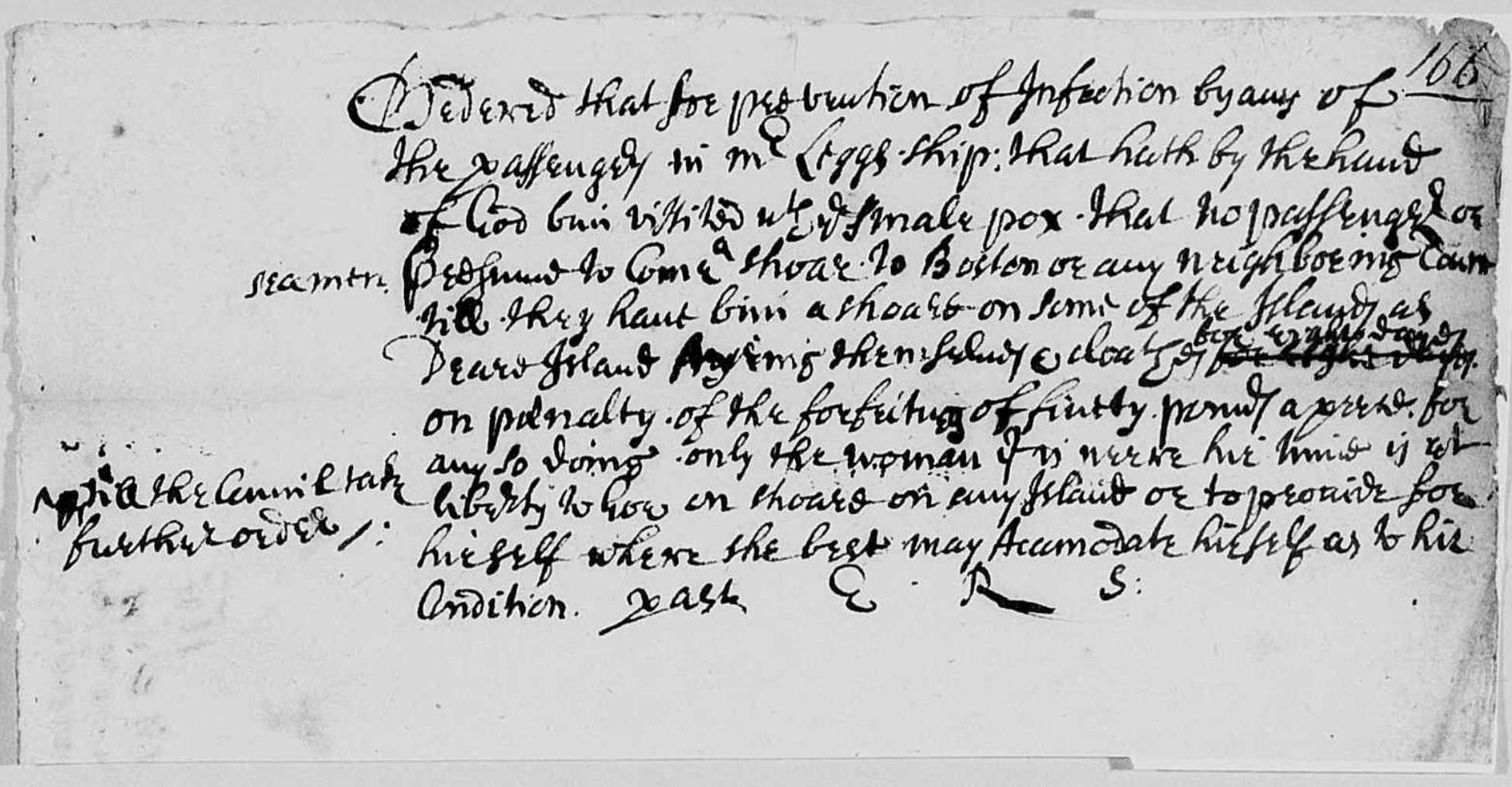
Ordered that for prevention of Infection by any of the passengers in Mr Leggs ship: that hath by the hand of God been visited with the small pox · that no passengers or persons to come ashore to Boston or any neighboring town till they have bin ashore on some of the Islands as <a href="https://en.wikipedia.org/wiki/Deer_Island_(Massachusetts)">Deare Island</a> ayring them selves and cloaths for eyght days on penalty · of the forfeiting of fivety pounds a piece for any so doing · only the women if is neere hir time is at liberty to gow on shoare on any Island or to provide for hirself where she may Accomodate herself as to hir condition
</p>
</blockquote>]]>
      </content>
    </entry>


    <entry>
      <title>Deborah Byar</title>
      <link rel="alternate" type="text/html" href="https://xefer.com/2021/12/byar" />
      <id>tag:xefer.com,2021://2.276</id>
      <published>2021-12-05T21:54:35Z</published>
      <updated>2022-01-04T21:07:08Z</updated>
      <summary type="html">From the records of the County Courts, Suffolk, Massachusetts, November 13, 1691 Deborah Byar convict by Testimonies &amp; by her owne confession of putting on men&apos;s Apparrell at severall times &amp; places, once in a public house. The Court order...</summary>
      <author>
          <name>Jeffrey</name>
          
      </author>
      
      <content type="html" xml:lang="en" xml:base="https://xefer.com/">
          <![CDATA[<p>From the records of the County Courts, Suffolk, Massachusetts, November 13, 1691</p>
<div class="figure">
<a href="/image/deborah.byar.large.png">
<img src="/image/deborah.byar.small.png"/>
</a>
</div>
<blockquote>
<p>
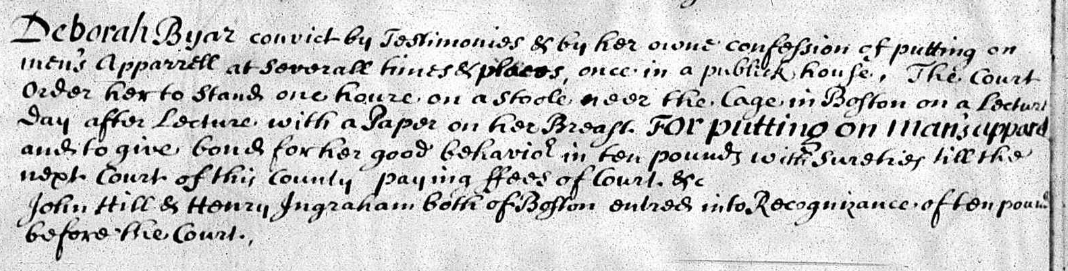
Deborah Byar convict by Testimonies & by her owne confession of putting on men's Apparrell at severall times & places, once in a public house.  The Court order her to stand one houre on a stoole neer the Cage in Boston on a Lecture Day<sup><a href="#fn1">1</a></sup> after Lecture with a Paper on her Breast.  <b>For putting on man's apparel</b> and to give bond for her good behavior in ten pounds with sureties till the next court of this county paying ffees of Court &c
</p>
</blockquote>
<p>
<sup id="fn1">1</sup> <a href="https://archive.org/details/customsandfashi00earlgoog/page/n248/mode/2up">Lecture Day</a> was a mid-week gathering, typically on Thursday, when crowds would collect at a meeting house or square to listen to a sermon</p>]]>
      </content>
    </entry>


    <entry>
      <title>Earliest View of London</title>
      <link rel="alternate" type="text/html" href="https://xefer.com/2013/10/london" />
      <id>tag:www.xefer.com,2013://2.274</id>
      <published>2013-10-19T00:02:36Z</published>
      <updated>2014-04-24T17:39:12Z</updated>
      <summary type="html"> Below are the earliest extant depictions of London. They are from the front matter of Matthew Paris&apos; Historia Anglorum and Chronica Majora written between 1250 and 1259. In both cases they are parts of strip maps showing pilgrimage routes...</summary>
      <author>
          <name>Jeffrey</name>
          
      </author>
      
      <content type="html" xml:lang="en" xml:base="https://xefer.com/">
          <![CDATA[<p>
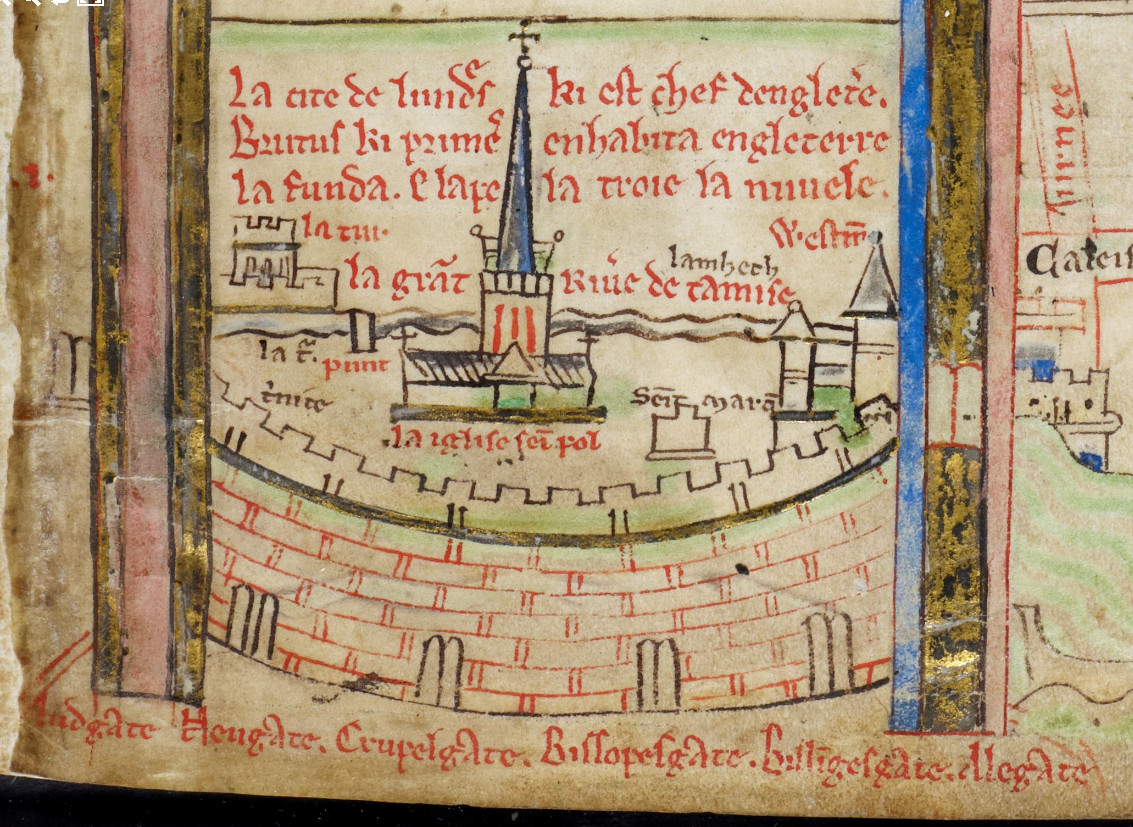
Below are the <a href="http://books.google.com/books?id=Oc8HAAAAQAAJ&pg=PA85#v=onepage&q&f=false">earliest extant</a> depictions of London.  They are from the front matter of Matthew Paris' <a href="http://www.bl.uk/manuscripts/FullDisplay.aspx?ref=Royal_MS_14_c_vii">Historia Anglorum</a> and <a href="http://parkerweb.stanford.edu/parker/actions/manuscript_description_long_display.do?ms_no=26">Chronica Majora</a> written between 1250 and 1259.  In both cases they are parts of strip maps showing pilgrimage routes from London to Rome and on to Jerusalem.
</p>
<div class="figure">
<a href="/image/london.ms16.large.jpg">
<img src="/image/london.ms16.small.jpg"/>
<p>London from Historia Anglorum, MS 14 C VI, f.2r</p>
</a>
</div>
<p>
While the view is obviously very figurative, it nevertheless contains several interesting details that make it more than a simple iconographic representation.  
</p>
<p>
The text is <a href="http://www.anglo-norman.net/">Anglo-Norman</a> and reads: <i>La cite de lundres ki est chef de engleterre. Brutus ki premere enhabita ngleterre la funda e lapela troie la nuvele</i>, "The city of London is the principle city of England. Brutus who was the first inhabitant of England, founded and named New Troy."   The idea that London was founded by the Trojan <a href="http://en.wikipedia.org/wiki/Brutus_of_Troy">Brutus</a> is a legend first mentioned in the 9th-century but made most famous by Geoffrey of Monmouth in his Historia Regum Britanniae. 
</p>
<p>
The city is shown to be <a href="http://en.wikipedia.org/wiki/London_Wall">walled</a> with six named gates: Ludgate, Neugate (Newgate), Crupelgate (Cripplegate), Bissopesgate (Bishopsgate), Bilingesgate (<a href="http://en.wikipedia.org/wiki/Billingsgate">Billingsgate</a>) and Alegate (Aldgate.)  It is situated along the banks of the Thames (<i>le grat riue de tamise</i>.)
</p>
<p>Saint Paul's Cathedral (<i>la iglise sie pol</i>) dominates the city. Other details (from left to right) include: <i>la tur</i>, the <a href="http://en.wikipedia.org/wiki/White_Tower_%28Tower_of_London%29">Tower</a>; <i>la punt</i>, the <a href="http://en.wikipedia.org/wiki/London_Bridge">bridge</a>; <i>trnite</i>, i.e., la trinite, for <a href="http://en.wikipedia.org/wiki/Holy_Trinity_Priory,_Aldgate">Holy Trinity at Aldgate</a>; across the river is shown <i>lambeth</i>, Lambeth; <i>seit mara</i>, <a href="http://en.wikipedia.org/wiki/St._Martin%27s_Le_Grand">Saint Martin's la Grande</a>; and finally <i>Westm</i>, <a href="http://en.wikipedia.org/wiki/Westminster_Abbey">Westminster</a>.
<div class="figure">
<img src="/image/london.ms26.jpg"/>
<p>London from Chronica Majora,  MS 26, f.i R</p>
</div>
<p>
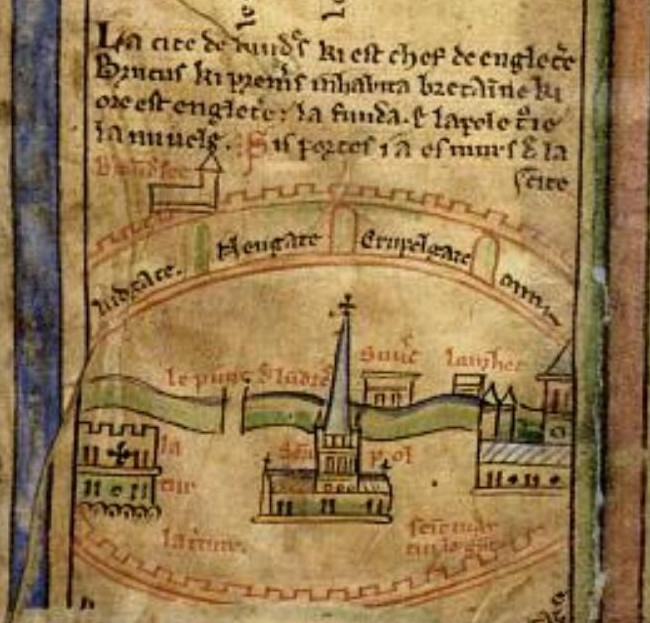
The view from the Chronica Majora may be the older of the two images shown. It is somewhat more fanciful, showing the city wall as circular and extending beyond the south bank of the Thames, which of course it never did.  It also only shows three, single-arched gates.  The view from the Historia Anglorum shows six, although four are show in the walls, while two are squeezed in along the margin almost as a correction.  They are also depicted correctly as double-arched.
</p>
<p>
The main text contains the additional sentence, <i>Sis portes i a es murs e la seit</i>, "Six gates are in the walls along with a seventh."  Suzanne Lewis, in her book, <a href="http://books.google.com/books?id=sXBdNsDxJ_cC">The Art of Matthew Paris in the Chronica Majora</a>, indicates that this reference to a seventh gate may either be a postern gate north of the Tower, or a barbican built outside of the Aldgate.
</p>
<p>
The Chronica view additionally includes a reference to <i>Birmundsee</i>, <a href="http://en.wikipedia.org/wiki/St_Mary_Magdalen_Bermondsey">Bermondsay</a>, outside the wall, and <i>Suuerc</i>, <a href="http://en.wikipedia.org/wiki/Southwark">Southwark</a>, on the south bank, but omits the Historia's explicit reference of Westminster.
</p>]]>
      </content>
    </entry>


    <entry>
      <title>Collective Guilt</title>
      <link rel="alternate" type="text/html" href="http://www.xefer.com/iuncturae/2013/10/273" />
      <id>tag:www.xefer.com,2013:/iuncturae//3.273</id>
      <published>2013-10-07T17:43:02Z</published>
      <updated>2013-10-08T15:08:29Z</updated>
      <summary type="html"> W. G. Sebald, on a physical manifestation of collective guilt: &quot;And indeed, to this day one sees in Belgium a distinctive ugliness, dating from the time when the Congo colony was exploited without restraint and manifested in a macabre...</summary>
      <author>
          <name>Jeffrey</name>
          
      </author>
      
      <content type="html" xml:lang="en" xml:base="http://www.xefer.com/iuncturae/">
          <![CDATA[<p>
<a href="http://en.wikipedia.org/wiki/W._G._Sebald">W. G. Sebald</a>, on a physical manifestation of collective guilt:
</p>
<blockquote>
<p>
"And indeed, to this day one sees in Belgium a distinctive ugliness, dating from the time when the Congo colony was exploited without restraint and manifested in a macabre atmosphere of certain salons and the strikingly stunted growth of the population, such as one rarely comes across elsewhere. At all events, I well recall that on my first visit to Brussels in December 1964 I encountered more hunchbacks and lunatics than normally in a whole year."
</p>
<p>...</p>
<p>
"At the far end of the room, in the dim light that entered by the Belgian bulls'-eye panes, sat a hunchbacked pensioner. She was wearing a woollen cap, a winter coat made of thick burled material, and fingerless gloves.  The waitress brought her a plate with a huge piece of meat. The old woman stared at it for a while, then produce from her handbag a small, sharp knife with a wooden handle and began to cut it up. She would have been born, it occurs to me now, at about the time that the Congo railway was completed."
</blockquote>
<p>
<a href="http://www.amazon.com/o/asin/0811214133/10030-20">The Rings of Saturn</a>, pp. 123, 127.
</p>]]>
      </content>
    </entry>


    <entry>
      <title>Annular Eclipse on Mars by Phobos</title>
      <link rel="alternate" type="text/html" href="https://xefer.com/2013/09/phobos" />
      <id>tag:www.xefer.com,2013://2.272</id>
      <published>2013-09-02T19:51:55Z</published>
      <updated>2016-11-20T16:24:08Z</updated>
      <summary type="html"> This is a short video I put together of an annular eclipse of the Sun by Phobos as captured by the Curiosity rover on Mars; August 17, 2013. The total elapsed time of the eclipse was about 30 seconds....</summary>
      <author>
          <name>Jeffrey</name>
          
      </author>
      
      <content type="html" xml:lang="en" xml:base="https://xefer.com/">
          <![CDATA[<p>
This is a short video I put together of an <a href="http://en.wikipedia.org/wiki/Solar_eclipse#Types">annular</a> eclipse of the Sun by <a href="http://en.wikipedia.org/wiki/Phobos_%28moon%29">Phobos</a> as captured by the <a href="http://en.wikipedia.org/wiki/Curiosity_%28rover%29">Curiosity</a> rover on Mars; August 17, 2013.
</p>
<object type="application/x-shockwave-flash" style="width: 650px; height: 450px;" data="https://www.youtube.com/v/LHMiiCuAYOE">
      <param name="movie" value="https://www.youtube.com/v/LHMiiCuAYOE&amp">
</object>
<p>
The total elapsed time of the eclipse was about 30 seconds.  This was sped up a bit (I put a shorter delay between images) to make things look a bit smoother.  For some reason about 2 seconds of imagery was missing from the NASA site, so I had to fill in a few frames making things look a bit jagged at the end.  I'm sure NASA will be able to put something nicer together than what I was able to do with some simple tools (e.g., <a href="http://www.gimp.org/">GIMP</a>.)  The raw imagery is <a href="http://mars.nasa.gov/msl/multimedia/raw/?s=369&camera=MAST_">here</a>.
</p>]]>
      </content>
    </entry>


    <entry>
      <title>Gothica Bononiensia</title>
      <link rel="alternate" type="text/html" href="https://xefer.com/2013/07/gothica" />
      <id>tag:www.xefer.com,2013://2.271</id>
      <published>2013-07-22T19:20:15Z</published>
      <updated>2014-04-24T17:37:46Z</updated>
      <summary type="html"> Professors Rosa Bianca Finazzi and Paola Tornaghi of The Università Cattolica del Sacro Cuore in Milan have published1 a magnificent analysis of a recently discovered 6th-century palimpsest of two folio pages containing previously unseen passages from the Gothic Bible....</summary>
      <author>
          <name>Jeffrey</name>
          
      </author>
      
      <content type="html" xml:lang="en" xml:base="https://xefer.com/">
          <![CDATA[<p>
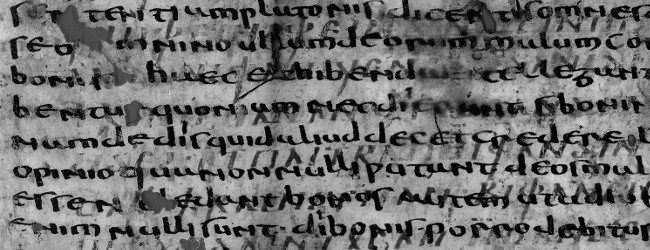
Professors <a href="http://docenti.unicatt.it/ita/Rosa_Bianca_Finazzi/">Rosa Bianca Finazzi</a> and <a href="http://docenti.unicatt.it/ita/Paola_Tornaghi/">Paola Tornaghi</a> of The <a href="http://en.wikipedia.org/wiki/Universit%C3%A0_Cattolica_del_Sacro_Cuore">Università Cattolica del Sacro Cuore</a> in Milan have published<sup>1</sup> a <a href="http://publicatt.unicatt.it/handle/10807/43265">magnificent analysis</a> of a recently discovered 6th-century palimpsest of two folio pages containing previously unseen passages from the <a href="http://en.wikipedia.org/wiki/Gothic_Bible">Gothic Bible</a>. 
</p>
<div class="figure">
<img src="/atdragan.jpg"/>
<p>The newly attested Gothic word "atdragan" from Isiah 14:14-15</p>
</div>
<p>
In the previous image I have highlighted the newly found word “atdragan” from Isaiah 14:14-15.
</p>
<p>
The fragment was originally of interest due to it being a very early witness to St. Augustine's “City of God”, an initial analysis and interpretation of which was published by Armando Antoelli, who provided the original dating.  During a subsequent paleographic analysis by the scholars Maddalena Modesti and Annafelicia Zuffrano, it was discovered that the Latin fragment was actually a palimpsest with a <i>scriptio inferior</i> in the <a href="http://en.wikipedia.org/wiki/Gothic_language">Gothic</a> language.
</p>
<p>
Finazzi and Tornaghi have given the Gothic text the name, <i>Gothica Bononiensia</i>, from where the fragment was found: the Basilica of San Petronio in Bologna. A complete transcription of the Gothic text and images from the article can be found <a href="http://www.gotica.de/bononiensia.html">here</a>.
</p>
<p>
From a linguistic perspective, one of the more exciting aspects of the find is the discovery of previously unattested words.  Forms of words that had only been reconstructed by linguists were found: 
<p>
<ul>
	<li><a href="/gothica#faro">farao</a> (pharaoh) f. 2v, 20</li>
	<li><a href="/gothica#magaþs">magaþs</a> (maiden) f. 2v, 7</li>
	<li><a href="/gothica#þiuþ">þiuþeins</a> (blessing) f. 1v, 20</li>
	<li><a href="/gothica#unfroþs">unfroþs</a> (foolish) f. 2r, 18</li>
	<li><a href="/gothica#unsibjis">unsibjis</a> (wicked) f. 2r, 20</li>
</ul>
<p>
(Finazzi and Tornaghi state that these forms will no longer need to carry asterisks in the Gothic dictionaries.)
</p>
<p>
... as well as words that have never been attested before:
</p>
<ul>
        <li><a href="/gothica#nabu">Nabukaudaunausaur</a> (Nebuchadnezzar, proper name) f. 2v, 22</li>
        <li><a href="/gothica#fairjan">fairjan</a> (to depart, distance, move away) f. 2v. 10-11</li>
	<li><a href="/gothica#ananamnjan">ananamnjan</a> (to label, nickname, call) f. 1v, 26</li>
	<li><a href="/gothica#atdragan">atdragan</a> (to pull down) f. 2r, 7</li>
	<li><a href="/gothica#fratrudan">fra[t]rudan</a> (to trample) f. 1r, 18</li>
	<li><a href="/gothica#gawitan">gawitan</a> (to defend) f. 1r, 6</li>
	<li><a href="/gothica#usþinsan">usþinsan</a> (to tear, pull) f. 2v, 24</li>
</ul>
<div class="figure">
<a href="/gothica">
<img src="/image/gothica1v.jpg"/>
</a>
<p>Enhanced photograph of f. 1v, 20-25; Gothic text in lighter gray</p>
</div>
<p>
The fragment contains a series of biblical passages that jump between the Old and New Testaments. The authors speculate that the different passage perhaps form the framework for a homily that could be referenced by a priest. Since some of passages are also found in the Wulfia bible, further study is needed to understand if the Gothic passages could have been translations based on different Greek or Latin sources than Wulfia's.
</p>
<p>
<sup>1</sup> <a href="http://publicatt.unicatt.it/handle/10807/43265">Gothica Bononiensia</a>: Analisi linguistica e filologica di un nuovo documento,  <a href="http://www.vponline.it/riviste/000193/">Aevum</a>, 87 (2013), fasc. 1, pp. 113-155), ISSN 0001-9593
</p>]]>
      </content>
    </entry>


    <entry>
      <title>Weather Station Kurt</title>
      <link rel="alternate" type="text/html" href="https://xefer.com/2013/03/kurt" />
      <id>tag:www.xefer.com,2013://2.270</id>
      <published>2013-03-25T00:04:20Z</published>
      <updated>2014-01-14T21:29:42Z</updated>
      <summary type="html"> Weather Station &quot;Kurt&quot;, officially WFL-26 (Wetter-Funkgerät Land-26) was an automated weather station installed in Northern Laborador on October 22, 1943, by a team from the German submarine U-537. It was the only German armed military operation on mainland North...</summary>
      <author>
          <name>Jeffrey</name>
          
      </author>
      
      <content type="html" xml:lang="en" xml:base="https://xefer.com/">
          <![CDATA[<p>
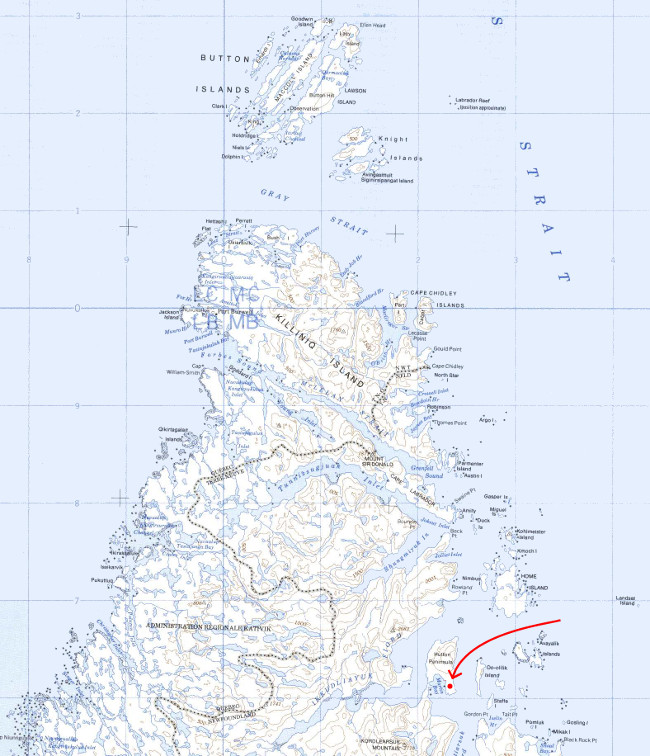
<a href="http://www.heritagedaily.com/2012/12/nazi-weather-station-kurt/">Weather Station "Kurt"</a>, officially WFL-26 (Wetter-Funkgerät Land-26) was an automated weather station installed in Northern Laborador on October 22, 1943, by a team from the German submarine U-537.  It was the only German armed military operation on mainland North American during World War II.
</p>
<div class="figure">
<img src="/image/025a_1_1.jpg"/>
<p>Northern tip of Labrador. Location of WFL-26</p>
</div>
<p>
At the outset of World War II, Germany could no longer receive important weather information from the Arctic from international weather services, and so began a program of installing manned and automatic stations across the region.  These were important for planning air missions over the Soviet Union and northern Europe.
</p>
<div class="figure">
<img src="/image/u-537.jpg"/>
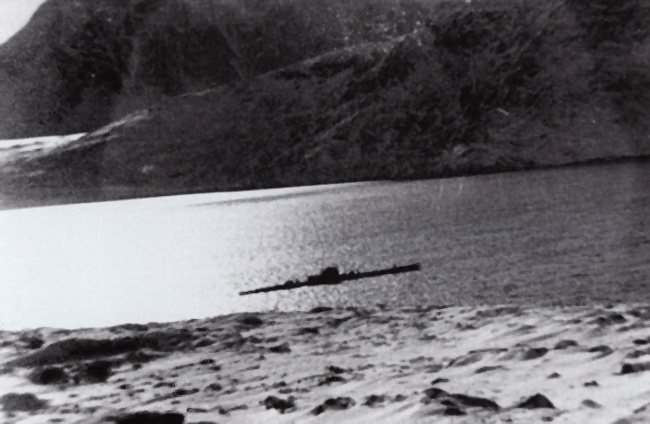
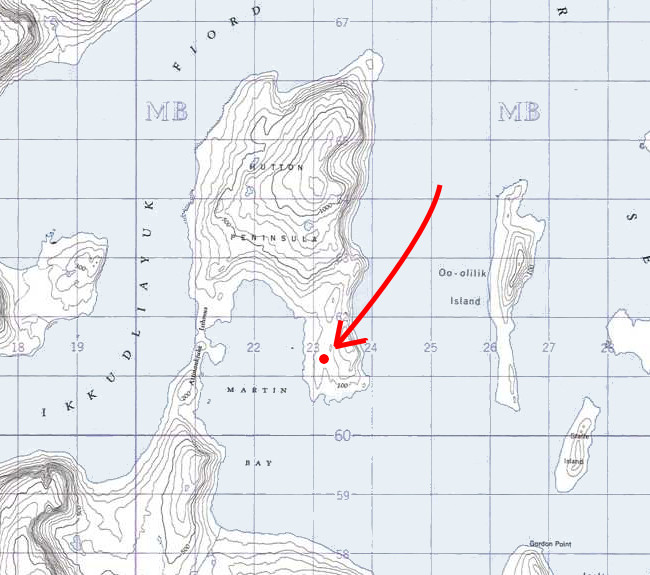
<p>U-537 anchored in Martin Bay, Hutton Peninsula, Northern Labrador</p>
</div>
<p>
In order to disguise the purpose of the station should it ever have been come across, the crew scattered packs of American cigarettes and labeled the equipment for the (non-existent) "Canadian Weather Service."  They apparently needn't have worried as the station was completely forgotten about.  Its existence was not rediscovered until a historian for Siemens Corporation, who had built the equipment, found it in the company archives.  An expedition to the site was then undertaken in 1981.
</p>
<div class="figure">
<img src="/image/025a01_w_1_0.jpg"/>
<p>Location of WFL-26</p>
</div>
<p>
</p>
<p>
For a full description of the mission to install this station, see "<a href="http://books.google.com/books?id=LJJez91DyYcC">U-Boats Against Canada: German Submarines in Canadian Waters</a>", by Michael L. Hadley, pp. <a href="http://books.google.com/books?id=LJJez91DyYcC&pg=PA163#v=onepage">163-167</a>.
</p>]]>
      </content>
    </entry>


    <entry>
      <title>The Phallus Tree of fr. 25526</title>
      <link rel="alternate" type="text/html" href="https://xefer.com/2013/03/phallus-tree" />
      <id>tag:www.xefer.com,2013://2.269</id>
      <published>2013-03-17T17:52:18Z</published>
      <updated>2014-04-24T17:38:49Z</updated>
      <summary type="html"> The Bibliothèque nationale de France houses a particularly strange manuscript of Guillaume de Lorris&apos; and Juen de Meun&apos;s Roman de la Rose: BNF fr. 25526. It is famous for its extensive bas-de-page images, several of which are of an...</summary>
      <author>
          <name>Jeffrey</name>
          
      </author>
      
      <content type="html" xml:lang="en" xml:base="https://xefer.com/">
          <![CDATA[<p>
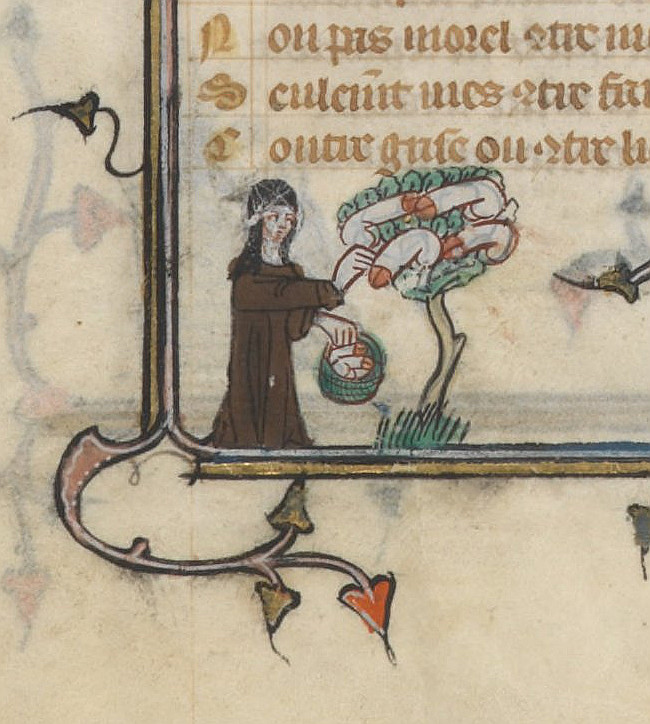
The Bibliothèque nationale de France houses a particularly strange manuscript of <a href="http://en.wikipedia.org/wiki/Guillaume_de_Lorris">Guillaume de Lorris</a>' and <a href="http://en.wikipedia.org/wiki/Jean_de_Meun">Juen de Meun</a>'s <a href="http://en.wikipedia.org/wiki/Roman_de_la_Rose">Roman de la Rose</a>: <a href="http://gallica.bnf.fr/ark:/12148/btv1b6000369q">BNF fr. 25526</a>.  It is famous for its extensive bas-de-page images, several of which are of an explicitly erotic nature.  One image in particular often serves as an exemplar of strange medieval marginalia - that found on page <a href="http://gallica.bnf.fr/ark:/12148/btv1b6000369q/f218.image">106v</a>, of a nun gathering the fruit of a phallus tree:
</p>
<div class="figure">
<img src="/image/phallus.jpg"/>
<p>Nun at Phallus Tree. BNF fr. 25526, 106r</p>
</div>
<p>
This single image is part of a series on pages 106r and 106v showing a nun and a friar engaged in erotic play. These same figures appear again on pages <a href="http://gallica.bnf.fr/ark:/12148/btv1b6000369q/f227.image">111r</a> and <a href="http://gallica.bnf.fr/ark:/12148/btv1b6000369q/f228.image">111v</a>.
</p>
<p>
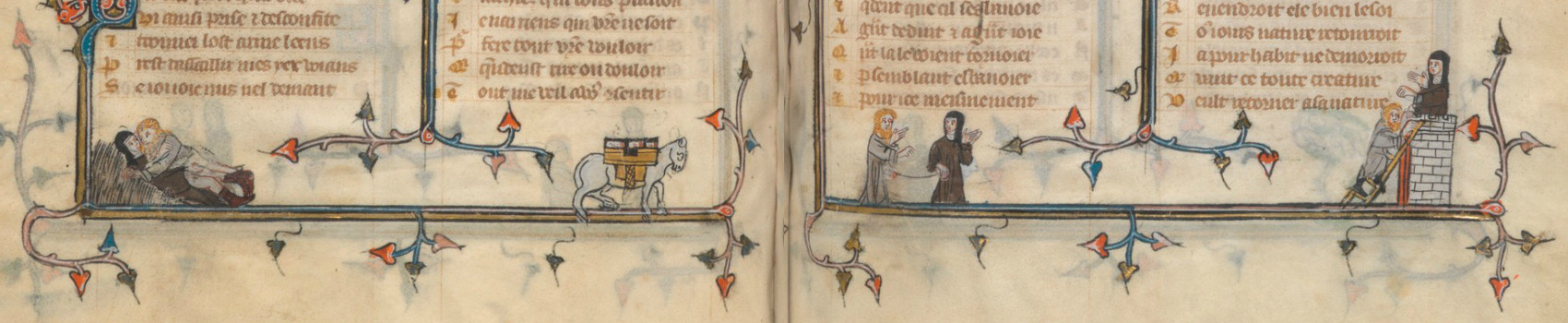
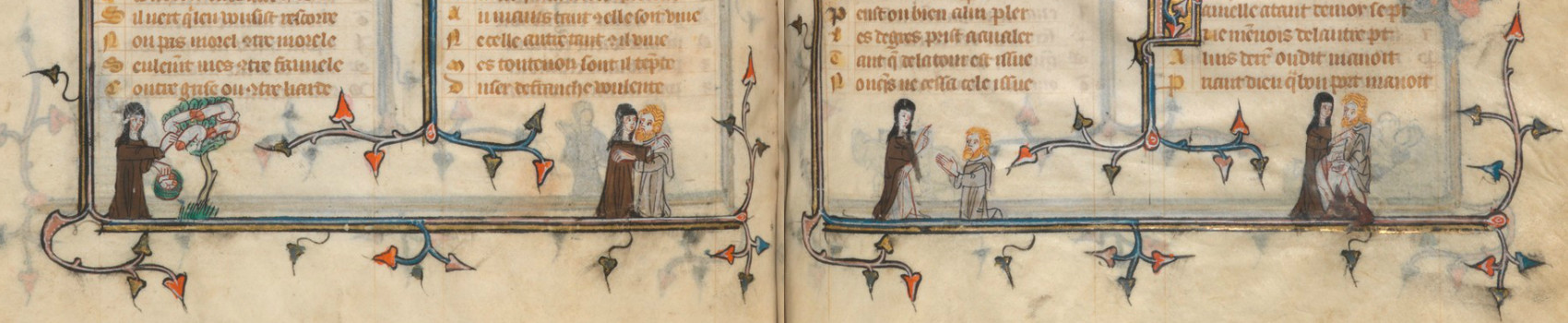
Interestingly in her book, “<a href="http://books.google.com/books/?id=qjyePwAACAAJ">Roman de la Rose and its Medieval Readers</a>”, Dr. <a href="http://www.mml.cam.ac.uk/french/staff/sh225/">Sylvia Huot</a> of Pembroke College, Cambridge points out that all of these images are part of a single bifolium; that is, a single double page that is folded in half and sewn into a quire.  From the perspective of the illustrator working on the bifolium, all eight individual images form one extended series:
</p>
<div class="figure">
<a href="/image/111v106r.jpg">
<img src="/image/111v106rs.jpg"/>
<p>111v : 106r</p>
</a>
</div>
<div class="figure">
<a href="/image/106v111r.jpg">
<img src="/image/106v111rs.jpg"/>
<p>106v : 111r</p>
</a>
</div>
<p>
Because the bifolium if folded in half, the images on the top right (i.e., 111v, Copulation; Mule with phalluses) becomes the final scene in the series:
</p>
<ul>
<li><a href="http://gallica.bnf.fr/ark:/12148/btv1b6000369q/f217.image">106r</a>: Nun leads monk, Monk scales tower</li>
<li><a href="http://gallica.bnf.fr/ark:/12148/btv1b6000369q/f218.image">106v</a>: Nun at phallus tree; Nun and monk embrace</li>
<li><a href="http://gallica.bnf.fr/ark:/12148/btv1b6000369q/f227.image">111r</a>: Monk kneels; Couple undresses</li>
<li><a href="http://gallica.bnf.fr/ark:/12148/btv1b6000369q/f228.image">111v</a>: Copulation; Mule with phalluses</li>
</ul>
<p>
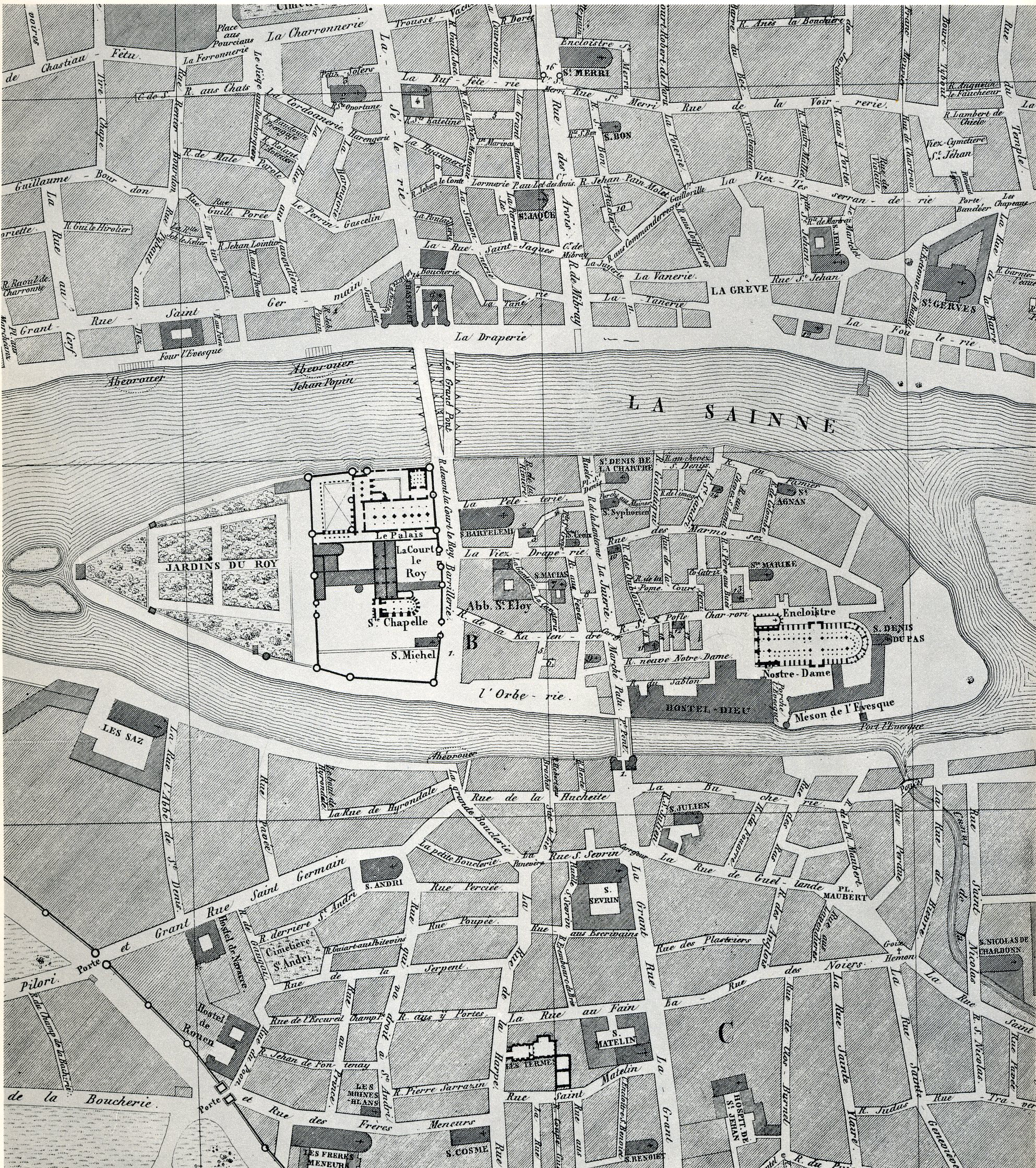
This manuscript was produced by the professional husband and wife team of Richard and Jean de Montbaston working out of their shop on the Rue Neuve Notre Dame in Paris. 
<div class="figure">
<a href="http://employees.oneonta.edu/farberas/arth/Images/ARTH_214images/Manuscripts/Paris/paris_large_150.jpg"><img src="/image/rueneuve.jpg"/></a>
<p>Highlight of 14th century Paris. Rue Nueve Notre Dame, center left</p>
</div>
<p>
In their book, "<a href="http://books.google.com/books?id=PoLgAAAAMAAJ">Manuscripts and their makers:
commercial book producers in medieval Paris, 1200-1500</a>", Richard and Mary Rouse, show that the wife, Jean de Montbaston, was responsible for virtually all the illustrations in fr. 25526 and that interestingly, she was most likely illiterate(!). Book makers such as the Montbastons worked as speedily as possible and devoted little if any time for literary interpretations.  Often in fact, their cursory view could result in illustrations that completely misrepresent the text.
</p>
<div class="figure">
<img src="/image/montbaston.jpg"/>
<p>Advertisement for Richard de Montbaston. <a href="http://gallica.bnf.fr/ark:/12148/btv1b84260044/f695.image.r=241.langEN">BNF fr. 241</a></p>
</div>
<p>
As specific and unambiguous as the tale appears to be, unfortunately, there is no known story which explicitly describes a friar and a nun as depicted in the bas-de-page images.  The Rouse's remark that the best that could be said is that they reflect some “bawdy tale” that Jean had perhaps heard during the course of her work.
</p>
<p>
That actual layout of the story is even in question.  Many of the illustrations in the book are temporally out of order.  For example, in the interleaving stories of the Passions of Christ and St. Margaret,  Montbaston seems to be aware that the left side of the bifolium will come after the right side when folded and so puts the left side image:
</p>
<ul>
<li>Descent from the Cross : Crucifixion</li>
<li>Burial : Resurrection</li>
</ul>
<p>
Here the illustrator understands that the Descent from the Cross occurs after the Crucifixion, and so puts that image to the <i>right</i>, thus when folded, Descent (53v) comes after Crucifixion (52r) .  But then, oddly, she puts the Burial and Resurrection on the other side of that bifolium.  This results in a confusing series of illustrations:
</p>
<ul>
<li><a href="http://gallica.bnf.fr/ark:/12148/btv1b6000369q/f109.image">52r</a>: Crucifixion</li>
<li><a href="http://gallica.bnf.fr/ark:/12148/btv1b6000369q/f110.image">52v</a>: Burial</li>
<li><a href="http://gallica.bnf.fr/ark:/12148/btv1b6000369q/f111.image">53r</a>: Resurrection</li>
<li><a href="http://gallica.bnf.fr/ark:/12148/btv1b6000369q/f112.image">53v</a>: Descent from the Cross</li>
</ul>
<div class="figure">
<img src="/image/52r53v.jpg"/>
<p>Passion of Christ bas-de-page images from 52r, 52v, 53r and 53v</a></p>
</div>
<p>
All of the aspects of the Passion stories follow this same disjointed pattern.
</p>
<p>
Does the erotic nun and friar tale follow this same pattern?  If so, the story would flow in a way that makes even less sense:
</p>
<ul>
<li><a href="http://gallica.bnf.fr/ark:/12148/btv1b6000369q/f217.image">106r</a>: Nun leads monk, Monk scales tower</li>
<li><a href="http://gallica.bnf.fr/ark:/12148/btv1b6000369q/f228.image">111v</a>: Copulation; Mule with phalluses</li>
<li><a href="http://gallica.bnf.fr/ark:/12148/btv1b6000369q/f218.image">106v</a>: Nun at phallus tree; Nun and monk embrace</li>
<li><a href="http://gallica.bnf.fr/ark:/12148/btv1b6000369q/f227.image">111r</a>: Monk kneels; Couple undresses</li>
</ul>
<p>
Given what is known about Jean de Montbaston's literacy and the speed with which she worked, the best I think can be said is that she managed to get the ordering "correct" this time.  Still, what ultimately is the source of these strange images?  Unfortunately, the answer is probably unknowable.
</p>
<p>
Images have phallus trees have appeared in other contexts, e.g., <a href="http://www.maremmaguide.com/art-in-the-middle-ages.html">The Massa Marittima Mural</a>, but any attempt to find meaning of them seems to result in series of circular references to the few examples that are known.
</p>]]>
      </content>
    </entry>


    <entry>
      <title>Massachusetts, 1810</title>
      <link rel="alternate" type="text/html" href="https://xefer.com/2013/02/massachusetts" />
      <id>tag:www.xefer.com,2013://2.268</id>
      <published>2013-02-02T19:48:02Z</published>
      <updated>2013-02-04T20:03:59Z</updated>
      <summary type="html"> A map showing the population distribution of Massachusetts based on the 1810 Federal census. It shows how remarkably and evenly distributed people were across the entire breadth of the state prior to industrialization. Massachusetts Population Distribution, 1810 The US...</summary>
      <author>
          <name>Jeffrey</name>
          
      </author>
      
      <content type="html" xml:lang="en" xml:base="https://xefer.com/">
          <![CDATA[<p>
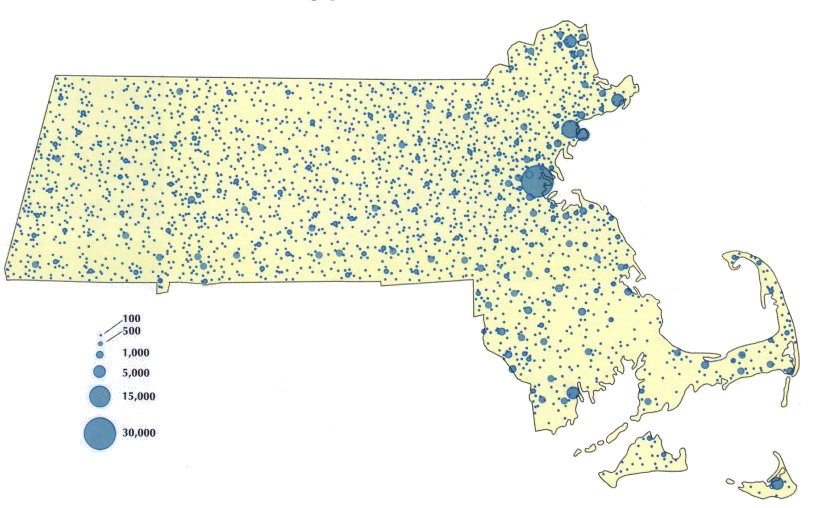
A map showing the population distribution of Massachusetts based on the 1810 Federal census.  It shows how remarkably and evenly distributed people were across the entire breadth of the state prior to industrialization.
</p>
<div class="figure">
<a href="/image/mass.1810.jpg">
<img src="/image/mass.1810s.jpg" alt="Mass Population 1810"/>
<p>Massachusetts Population Distribution, 1810</p>
</a>
</div>
<blockquote>
<p>
The US Census of 1810 counted 421,040 inhabitants, with 79% of them dispersed in rural areas or in villages of under 2,500 people. Counties with the largest populations were Essex (71,888), Worcester (64,910), and Middlesex (52,789). The four western counties had a quarter of the population of the state (112,182), the greatest 
proportion that region ever achieved.  The largest citIes were Boston&mdash;33,250 (4th in US), Salem&mdash;12,613 (7th in US), Newburyport&mdash;7,634 (12th in US), and Nantucket&mdash;6,807 (14th in US). In 1810, one in 15 Americans lived in Massachusetts.
</p>
</blockquote>
<p>
Wilkie, Richard W.  and Tager, Jack. "<a href="http://www.geo.umass.edu/faculty/wilkie/Wilkie/maps.html">Historical Atlas of Massachusetts</a>". University of Massachusetts Press, 1991.
</p>
]]>
      </content>
    </entry>


    <entry>
      <title>More on &quot;Twitter&quot;</title>
      <link rel="alternate" type="text/html" href="https://xefer.com/2012/11/twitter" />
      <id>tag:www.xefer.com,2012://2.267</id>
      <published>2012-11-05T18:37:03Z</published>
      <updated>2014-01-13T18:03:55Z</updated>
      <summary type="html"> Notker Labeo (c950 - 1022) used the Old High German cognate of &quot;twitter&quot; for the Latin &quot;susurrare&quot; in exactly the same place as Chaucer in this own translation of Boethius in the early 11th century. This is from page...</summary>
      <author>
          <name>Jeffrey</name>
          
      </author>
      
      <content type="html" xml:lang="en" xml:base="https://xefer.com/">
          <![CDATA[<p>
<a href="http://en.wikipedia.org/wiki/Notker_Labeo">Notker Labeo</a> (c950 - 1022) used the <a href="http://en.wikipedia.org/wiki/Old_High_German">Old High German</a> cognate of "twitter" for the Latin "susurrare" in exactly the same place as Chaucer in this own <a href="http://www.e-codices.unifr.ch/en/list/one/csg/0825">translation</a> of Boethius in the early 11th century.
</p>
<p>
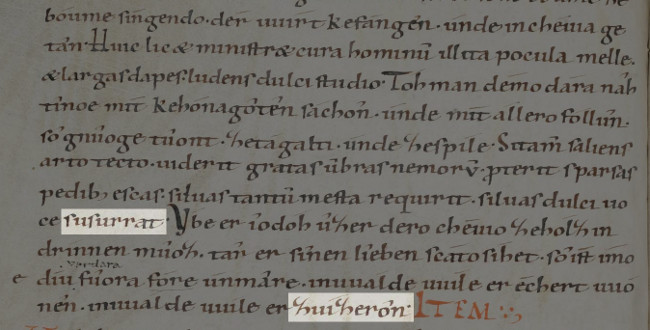
This is from page 118 of the manuscript.  The Latin appears first followed by the translated OHG.  Where Chaucer translated "susurrat" as "twitreþ", Notker used its cognate "zwizeron".
</p>
<div class="figure">
<a href="http://www.e-codices.unifr.ch/en/csg/0825/118/medium">
<img src="/image/notker.jpg" alt="Notker's Boethius p. 118"/>
<p>Stiftsbibliothek, Codex 825: Boethius, De consolatione philosophiae</p>
</a>
</div>
<p>
The original and translated sentences are then,
</p>
<blockquote><p>Boethius: "Sylvas dulci voce <b>susurrat</b>."</p></blockquote>
<blockquote><p>Notker: "in uuálde uuíle er <b>zuízerôn</b>."</p></blockquote>
<blockquote><p>Chaucer:  "<b>Twitriþ</b> desiryinge þe wood wiþ her swete voys."</p></blockquote>
<p>
"zwizeron", pronounced "tswitseron" shares the same West Germanic antecedent as "twitter".  In fact, before the 2nd phase of the <a href="http://en.wikipedia.org/wiki/High_German_consonant_shift">Germanic Consonant Shift</a> (t&rarr;ts), it would have been pronounced "twiteron".  Old English did not participate in the Shift and so kept the hard "t".
</p>
<p>
Chaucer undoubtedly did not coin the word "twitter" as it must have existed in Old English; it is pure happenstance that it was not attested in any other surviving document.  The English "twitter" is in fact closer to the original West Germanic version of the word.
</p>]]>
      </content>
    </entry>


    <entry>
      <title>Chaucer and &quot;Twitter&quot;</title>
      <link rel="alternate" type="text/html" href="https://xefer.com/2012/10/chaucer" />
      <id>tag:www.xefer.com,2012://2.266</id>
      <published>2012-10-29T23:48:40Z</published>
      <updated>2014-04-25T14:05:56Z</updated>
      <summary type="html"> The Atlantic Magazine recently mentioned a tweet from the Oxford English Dictionary noting that Geoffrey Chaucer has the earliest attested use of the word &quot;twitter&quot;. It comes from his translation of Boethius&apos;s &quot;De Consolatione Philosophiæ&quot;, which he called &quot;Boece&quot;...</summary>
      <author>
          <name>Jeffrey</name>
          
      </author>
      
      <content type="html" xml:lang="en" xml:base="https://xefer.com/">
          <![CDATA[<p>
The Atlantic Magazine recently <a href="http://www.theatlanticwire.com/entertainment/2012/10/chaucer-coined-twitter/58374/">mentioned</a> a <a href="https://twitter.com/OEDonline/status/261469663853150210">tweet</a> from the Oxford English Dictionary noting that <a href="http://en.wikipedia.org/wiki/Geoffrey_Chaucer">Geoffrey Chaucer</a> has the earliest attested use of the word "twitter".  It comes from his translation of <a href="http://en.wikipedia.org/wiki/Boethius">Boethius</a>'s  "<a href="http://en.wikipedia.org/wiki/Consolation_of_Philosophy">De Consolatione Philosophiæ</a>", which he called "<a href="http://en.wikipedia.org/wiki/Boece_%28Chaucer%29">Boece</a>" (1380).
</p>
<p>
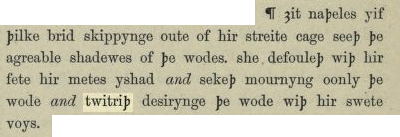
The usage in question is (in Middle English)
</p>
<div class="figure">
<a href="http://books.google.com/books?pg=PA68&id=elgJAAAAQAAJ">
<img src="/image/twitter.png" alt="Chaucer's use of 'twitter'"/>
</a>
<p>Boece; Book III, Metrum II</p>
</div>
<p>
Or:
</p>
<blockquote>
Yet nevertheless, if such a bird springs out of her tight cage, sees the agreeable shadows of the woods, she befouls with her feet her scattered food, and seeks mourning only the wood and twitters desiring the wood with her sweet voice.
</blockquote>
<p>
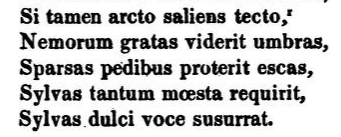
Chaucer was translating Boethius's original Latin.  I was interested to see what word he attempted to capture. The original sentence was:
</p>
<div class="figure">
<a href="http://books.google.com/books?id=1vhLAAAAYAAJ&pg=PA236">
<img src="/image/boethius.png" alt="Boethius original"/>
</a>
<p>De Consolatione Philosophiæ, Liber III, Metrum II, 21-25</p>
</div>
<p>The last line is "whispers to the woods with her sweet voice", so the word in question here is "susurrare", "to whisper or murmur"</p>
<p>Chaucer was also consulting <a href="http://en.wikipedia.org/wiki/Jean_de_Meun">Jean de Meun</a>'s 13th-century translation written in Old French to guide his own.  Meun's translation was:
<div class="figure">
<a href="http://books.google.com/books?id=AD7Mo598RnwC&pg=PA95">
<img src="/image/jmeun.png" alt="Meun's Old French"/>
</a>
</div>
<p>
Other than "douce voiz", i.e., "sweet voice" there is nothing there alluding to the timbre of this voice.  It seems to be an affectation that Meun ignores and Chaucer retains.
</p>
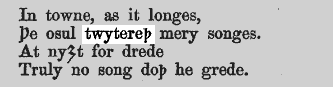
<p>The next most recent attestation to "twitter" according to the OED is from <a href="http://en.wikipedia.org/wiki/John_Trevisa">John Trevisa</a>'s translations of <a href="http://en.wikipedia.org/wiki/Ranulf_Higden">Ranulf Higden</a>'s Prolicionycion (1387)
<div class="figure">
<a href="http://books.google.com/books?id=cm3SAAAAMAAJ&pg=PA237">
<img src="/image/trevisa.png" alt="Travisa's use of 'twitter'"/>
</a>
</div>
<p>Or:</p>
<blockquote>
In town as it longes (lounges)<br/>
The osel (blackbird) twitters in merry songs<br/>
At night for dread<br/>
Truly no song does he grede (cry out)<br/>
</blockquote>
<p>
The original Latin here reads:
</p>
<div class="figure">
<a href="http://books.google.com/books?id=cm3SAAAAMAAJ&pg=PA236">
<img src="/image/higden.png" alt="Hidgen's original"/>
</a>
<p>Polychronicon Ranulphi Higden Monachi Cestrensis, p. 236</p>
</div>
<p>
So, "pulchris zinzitat"; or "chirps beautifully". So Trevisa was translating the rarer word "zinzitare".
</p>
<p>
It's interesting that "susarrare" and "zinizitare" both have a dual constant sound "s-s", "z-z" similar to "twitter", "t-t".  In all cases they are onomatopoetic. Also, recent scholar ship has Chaucer writing 'Boece' in ~1380, not 1374 as the OED lists, and Trevisa started writing is translation in 1385 bring the dates of their usage closer together.  It's impossible to say if Chaucer actually coined the word and Trevisa made use of it, or if it was in usage during that time.
</p> 
<p>
The OED gives the etymology of "twitter" simply as: "Of imitative origin: compare Old High German <i>zwizirôn , -erôn</i>".   There's no indication of any Latin derivation, but I can help but noticing the similarity between "zwizerôn" and "zinzitare".  Ultimately it may be that Chaucer simply was groping for a more poetic word with avian connotations given the context and chose one with both a direct influence from the low countries and had a close analogue in Latin.
</p>]]>
      </content>
    </entry>


    <entry>
      <title>S0-102</title>
      <link rel="alternate" type="text/html" href="https://xefer.com/2012/10/S0-102" />
      <id>tag:www.xefer.com,2012://2.265</id>
      <published>2012-10-20T21:36:14Z</published>
      <updated>2013-02-19T13:20:06Z</updated>
      <summary type="html"> Scientists at the University of California recently announced the discovery of a star with the shortest known period orbiting around the black hole at the center of the Milky Way (Sagittarius A*) at only 11.5 years. The new star...</summary>
      <author>
          <name>Jeffrey</name>
          
      </author>
      
      <content type="html" xml:lang="en" xml:base="https://xefer.com/">
          <![CDATA[<p>
Scientists at the University of California recently <a href="http://arxiv.org/pdf/1210.1294v1.pdf">announced</a> the discovery of a star with the shortest known period orbiting around the black hole at the center of the Milky Way (<a href="http://en.wikipedia.org/wiki/Sagittarius_A*">Sagittarius A*</a>) at only 11.5 years.   The new star has been designated "<a href="http://en.wikipedia.org/wiki/S0-102">S0-102</a>". 
</p>
<p>
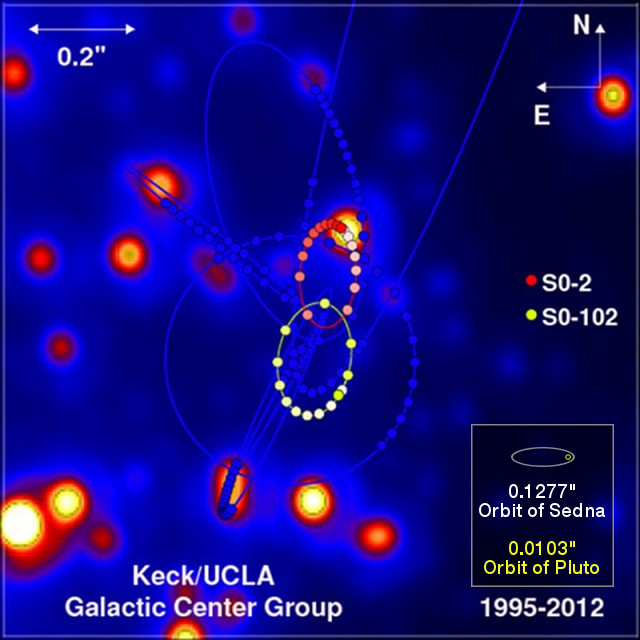
A diagram accompanying the announcement shows the orbit of both S0-102 and <a href="http://en.wikipedia.org/wiki/S2">S0-2</a>, the star with the previous shortest known period (as well as the orbit of various other stars buzzing around the black hole.)
</p>
<div class="figure">
  <img src="/image/orbit.jpg" alt="Diagram showing orbits of stars around Sagittarius A*"/>
</div>
<p>
To provide a sense of scale, I added a small sub-diagram showing the relative size of the orbits of <a href="http://en.wikipedia.org/wiki/90377_Sedna">Sedna</a> and <a href="http://en.wikipedia.org/wiki/Pluto">Pluto</a>.  Sedna has the largest known aphelion of any body orbiting the sun other than some long-period comets; still, this shows that the neighborhood of Sagittarius A* is comparable in scale to that of the Sun, though of course with far greater gravitational intensity.
</p>
<p>
Some basic trigonometry indicates that the .2 arc seconds shown on the diagram represents about <a href="http://www.wolframalpha.com/input/?i=tan%28.2+arc+seconds%29+*+%28distance+to+Sagittarius+A*%29+in+light+days">8.8 light days</a>.  Which is amazingly compact given the usual distances associated with stars.  (Or course, that is over 140 billion miles, so it is only <i>relatively</i> compact.) Computing the relative sizes of Senda's and Pluto's orbits are equally straightforward, coming out to <a href="http://www.wolframalpha.com/input/?i=arctan%28%28major+axis+of+Sedna%29%2F%28distance+to+Sagittarius+A*%29%29+radians">.1277 arc seconds</a> and .0103 arc seconds respectively.
</p>
<p>
To get a sense of the enormity of the Milky Way's black hole, consider that Sedna orbits the Sun in about 11,700 years.  Sagittarius A* pulls S0-102 through its orbit in only 11.5 years.  S0-102 reaches over 1% the speed of light at perihelion.
</p>]]>
      </content>
    </entry>


    <entry>
      <title>David Foster Wallace, Thomas Pynchon and the Brockengespenst</title>
      <link rel="alternate" type="text/html" href="https://xefer.com/2012/07/brocken" />
      <id>tag:www.xefer.com,2012://2.264</id>
      <published>2012-07-29T21:25:12Z</published>
      <updated>2021-12-05T22:25:28Z</updated>
      <summary type="html"> There is an incident in David Foster Wallace&apos;s &quot;Infinite Jest&quot; (1996) that is a direct reference to Thomas Pychon&apos;s &quot;Gravity&apos;s Rainbow&quot; (1973). I believe though that this is actually part of a chain of references going back to Goethe....</summary>
      <author>
          <name>Jeffrey</name>
          
      </author>
      
      <content type="html" xml:lang="en" xml:base="https://xefer.com/">
          <![CDATA[<div class="basicimg" style="width:100%">
<a href="http://amazon.com/o/asin/0140449019/10030-20">
<img src="http://images.amazon.com/images/P/0385031149.01.TZZZZZZZ" alt="Faust" title="" />
</a>
<a href="http://amazon.com/o/asin/0679723420/10030-20">
<img src="http://images.amazon.com/images/P/0679723420.01.TZZZZZZZ" alt="Pale Fire" title="" />
</a>
<a href="http://amazon.com/o/asin/B000QXSQSO/10030-20">
<img src="http://ecx.images-amazon.com/images/I/61xkK7GmWxL._SL110_.jpg" alt="The Berkshire Hills" title="" />
</a>
<a href="http://amazon.com/o/asin/0143039946/10030-20">
<img src="http://images.amazon.com/images/P/0143039946.01.TZZZZZZZ" alt="Gravity's Rainbow" title="" />
</a>
<a href="http://amazon.com/o/asin/0316920045/10030-20">
<img src="http://images.amazon.com/images/P/0316920045.01.TZZZZZZZ" alt="Infinite Jest" title="" />
</a>
</div>
</p>
<p style="float:clear">There is an incident in David Foster Wallace's "Infinite Jest" (1996) that is a direct reference to Thomas Pychon's "Gravity's Rainbow" (1973). I believe though that this is actually part of a chain of references going back to Goethe.</p>
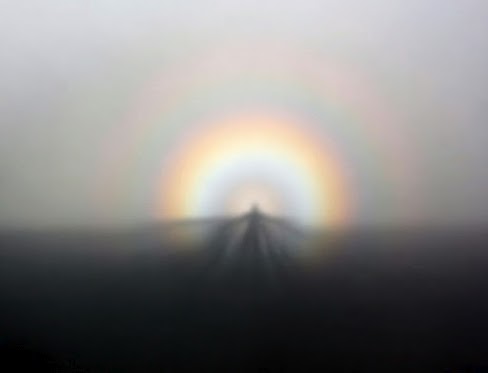
<p>In this scene from Infinite Jest, two characters on a mountain top are making shadows in the rising sun:<p>
<blockquote>
<p>Marathe watched a column of shadow spread again out east over the desert’s floor as Steeply got a hand under himself and rose, a huge and well-fed figure tottering on heels.  The two men sent together a strange <b>Brokengespenst</b>-shadow out toward the city Tuscon, a shadow round and radial at the base and jagged at the top, from Steeply’s wig becoming uncombed in his descent.</p><p>Infinite Jest, p. 89</p>
</blockquote>
<div class="figure">
<img src="/image/brockengespenst1.jpg" alt="brockengespenst"/>
</div>
<p>The allusion is to this scene from Gravity's Rainbow <sup id="fnr1-brocken"><a href="#fn1-brocken">1</a></sup>:</p>
<blockquote>
<p>... Here are Slothrop and the apprentice witch Geli Tripping, standing on top of the Broken, the very plexus of German evil, twenty miles north by northwest of Mittelwerke, waiting for the sun to rise. ...</p>
<p>As the sunlight strikes their backs, coming in nearly flat on, it begins developing on the peal cloudbank; two gigantic shaows, thrown miles overland, past Clausthal-Zelterfeld, past Seesen and Goslar, across where the river Leine would be, and reaching toward Weser. … “By golly,” Slothrop a little bit neros, “it’s the Specter.” You got it up around Greylock in the Berkshires too.  Around these parts its is known as the <b>Brockengespenst</b>.</p>
<p>... They are enormous, dancing the floor of the whole visible sky. He reaches underneath her dress.  She twines a leg around one of his. The spectra was red to indigo, tidal, immense, at all their edges. Under the clouds out there it's as still, and lost, as Atlantis.</p>
<p>Gravity’s Rainbow, p. 335</p>
</blockquote>
<p>A few pages earlier there is this bit of conversation between Geli and Slothrop:</p>
<blockquote>
"Have you been up to the Brocken yet?"<br/>
"Just hit town, actually."<br/>
"I've been up there every <a href="http://en.wikipedia.org/wiki/Walpurgis_Night">Walpurgisnacht</a> since I had my first period.  I'll take you, if you like."<br/>
<p>Gravity's Rainbow, p. 326</p>
</blockquote>
<p>In the introduction to his book of short stories, "Slow Learner" (1984), Pynchon mentions the book, "The Berkshire Hills" (1939), which was produced as part of Federal Writers' Project of the Works Progress Administration for Massachusetts. That book contains a mention of the Brockengespenst:</p>  
<blockquote>
<p>Thirty years ago, at the end of the summer season, a Berkshire man was bringing down the piano from the little recreation house atop the mountain. Suddenly he saw himself, his horse and wagon and the piano standing upright, outlined in monstrous design against the sky. Unable to decide whether he had quaffed too much from the "cup that cheers," he is said to have fled in haste from the mountainside to the minister, and taken the pledge at once.  
</p>
<p>
 The phenomenon of a gigantic shadow of an object reflected in a cloud is so well known as to have a German name, the Brockengespenst (Specter of the Brocken) from Brocken, the highest peak of the Hartz Mountains. As Greylockgespenst would be a bit unwieldy for Berkshire, here it is simply called the Specter. C. H. Towne tells more about it in his Autumn Loitering. <sup id="fnr2-brocken"><a href="#fn2-brocken">2</a></sup></p>
<p>The Berkshire Hills, p. 42</p>
</blockquote>
<p>It's clear that Pynchon initially found the reference to Brokengespenst from his fascination with Berkshire book, but note the occult aspects he introduces: Geli being a witch; satyric entwinings; Walpurgisnacht, etc. These elements are not part of the Berkshire Hills background story.</p>
<p>Pynchon is known for his wide-ranging references, so it's impossible to say exactly where he was introduced to the German mythology surrounding the mountain. I believe there is a connection to Nabokov however.</p>
<p>There is a oblique reference to The Brocken in Nabokov's "Pale Fire" (1961):</p>
<blockquote>
<p>During the fortnight that I had my demons fill my goetic mirror to overflow with those pink and mauve cliffs and black junipers and winding roads and sage brush changing to grass and lush blue flowers, and death-pale aspens, and an endless sequence of green-shorted Kinbotes meeting an anthology of poets and a <b>brocken</b> of their wives, I must have made some awful mistake in my incantations, for the mountain slope is dry and drear, and the Hurleys' tumble-down ranch, lifeless.</p>
<p>Pale Fire, p. 141</p>
</blockquote>
<p>
Here the protagonist, Kinbote, is in essence comparing Shade's wife - a rival for his affections - to a witch.
</p>
<p>As a student at Cornell, Pynchon attended Nabokov's lectures while he was teaching Russian and European literature. There is <a href="http://gravitys-rainbow.pynchonwiki.com/wiki/index.php?title=Pages_244-249#Page_246">speculation</a> that his character Blodgett Waxwing from Gravity's Rainbow is a reference to the famous opening line of Pale Fire's poem
 <sup id="fnr3-brocken"><a href="#fn3-brocken">3</a></sup>.  Could Nabokov's reference to The Broken have induced Pynchon to dig deeper into its inherent paganism?</p>
<p>
Nabokov was obviously aware enough of The Broken to produce such an arcane neologism with its biting implication of witchcraft. It is understood that this is a direct <a href="http://palefireconcordance.pbworks.com/w/page/13786336/B">reference</a> to Goethe's "Faust".  Even the use of the word "goetic" (~Goethe) in the same paragraph referenced above <a href="http://nnyhav.blogspot.com/2012/03/realighting-on-pale-fire.html">hints</a> at this.
</p>
<p>
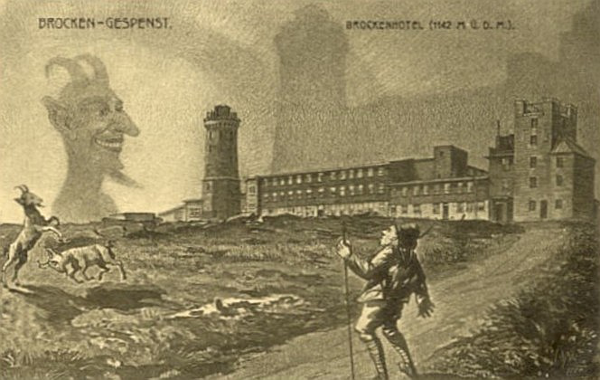
Goethe described the Brocken in his "Faust" (1808), as the center of revelry for witches on Walpurgisnacht.
<blockquote>
<p>
    Now to the <b>Brocken</b> the witches ride;<br/>
    The stubble is gold and the corn is green;<br/>
    There is the carnival crew to be seen,<br/>
    And Squire Urianus will come to preside.<br/>
    So over the valleys our company floats,<br/>
    With witches a-farting on stinking old goats.<br/>
</p>
</blockquote>
<div class="figure">
<img src="/image/brockengespenst2s.png" alt="brockengespenst"/>
</div>
<p>
Note: I was tempted to try and find a link to Thomas Mann's "The Magic Mountain" (1924), and its references to Walpurgisnacht, through there was nothing obvious, it is easy to imagine that it influenced Pynchon or even Nabokov, despite his noted criticism of him.
</p>
<p>
<sup id="fn1-brocken"><a href="#fnr1-brocken">1</a></sup>
Wallace himself confirms this in an <a href="http://www.badgerinternet.com/~bobkat/jestwiley2.html">interview</a> from 1997:</p>
<blockquote>
<p>
"That thing in Infinite Jest where two representatives (Steeply and Marathe) of two countries are on a cliff-side and are making enormous shadows and playing with it -- and there's even the use of the word Brockengespenst, which comes out of Slothrop and Geli Tripping (from Gravity's Rainbow) fucking on the Brockengespenst-- that's an outright allusion."
</p>
</blockquote>
<p>
<sup id="fn2-brocken"><a href="#fnr2-brocken">2</a></sup>
I could find no reference to this book anywhere. <i>Update</i>: the book is actually called "<a href="http://archive.org/details/autumnloiterers00towngoog">Autumn Loiterers</a>" by Charles Hanson Towne:
<blockquote>
<p>
As I have said, it was sunset time, and the hills were a riot of colour. It is on a high mountain near Williamstown, so the legend has it, that a certain man may be seen moving at the close of day—moving his furniture in 
a great van, a giant illusion, due, it is said, to some mysterious atmospheric condition. We did not see this monstrous phantom, though I confess that, having heard of it, I was humanly curious about it. Perhaps the 
atmospheric conditions were not right. If that is so, I am glad; for a more perfect afternoon I have never known, and I would rather experience reality than an illusion. 
</p>
<p>
Autumn Loiterers, pp. 79-80.
</p>
</blockquote>
</p>
<p>
<sup id="fn3-brocken"><a href="#fnr3-brocken">3</a></sup>
Pale Fire, Canto 1:<blockquote>
<p>
I was the shadow of the waxwing slain<br/>
By the false azure in the windowpane<br/>
I was the smudge of ashen fluff--and I<br/>
Lived on, flew on, in the reflected sky,<br/>
</p>
</blockquote>]]>
      </content>
    </entry>


    <entry>
      <title>Asgard</title>
      <link rel="alternate" type="text/html" href="https://xefer.com/2011/11/Asgard" />
      <id>tag:www.xefer.com,2011://2.263</id>
      <published>2011-11-17T14:08:30Z</published>
      <updated>2012-06-01T13:27:38Z</updated>
      <summary type="html"> Even though I probably know better, I can&apos;t help but view the Arctic romantically. So, while some of the hooting, &quot;extreme sport&quot; carrying-on in this clip from The Asgard Project is a bit annoying, the visuals look great: The...</summary>
      <author>
          <name>Jeffrey</name>
          
      </author>
      
      <content type="html" xml:lang="en" xml:base="https://xefer.com/">
          <![CDATA[<p>
Even though I probably <a href="http://www.amazon.com/o/asin/1586486365/10030-20">know better</a>, I can't help but view the Arctic <a href="http://www.amazon.com/o/asin/0375727485/10030-20">romantically</a>.  So, while some of the hooting, "extreme sport" carrying-on in this clip from <a href="http://www.theasgardproject.com/">The Asgard Project</a> is a bit annoying, the visuals look great:
</p>
<object type="application/x-shockwave-flash" style="width:600px; height:350px;" data="http://vimeo.com/moogaloop.swf?clip_id=11816131&amp;server=vimeo.com&amp;show_title=0&amp;show_byline=0&amp;show_portrait=0&amp;color=ff9933&amp;fullscreen=1" allowfullscreen="true" allowscriptaccess="always">
<param name="movie" value="http://vimeo.com/moogaloop.swf?clip_id=11816131&amp;server=vimeo.com&amp;show_title=0&amp;show_byline=0&amp;show_portrait=0&amp;color=ff9933&amp;fullscreen=1" allowfullscreen="true" allowscriptaccess="always" />
</object>
<p>
The film has won several <a href="http://www.outdoorsmagic.com/thoughts-from-the-outdoors/straight-outta-banff/7564.html">awards</a>, so I really want to see it eventually.
</p>
<p>
The views of <a href="http://en.wikipedia.org/wiki/Mount_Asgard">Asgard</a> shown in the clip don't really do justice to just how dramatic the mountain can appear. It looks like something you imagine could only be located in Mordor.
</p>
<div class="figure">
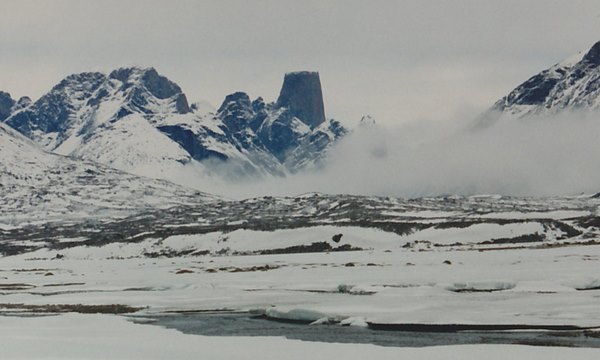
<img src="/image/asgard.jpg" alt="Mt. Asgard"/>
<p>Mt. Asgard, Baffin Island, 1994</p>
</div>
<p>
I set up my camp in a snow storm and didn't have any real idea where Asgard was when I settled in.  In the morning the skies had mostly cleared and this is the sight before me when I opened my tent.  Awesome.
</p>]]>
      </content>
    </entry>


    <entry>
      <title>Swell</title>
      <link rel="alternate" type="text/html" href="https://xefer.com/2011/10/swell" />
      <id>tag:www.xefer.com,2011://2.262</id>
      <published>2011-10-25T13:40:02Z</published>
      <updated>2012-11-16T23:43:09Z</updated>
      <summary type="html"> My friend Cory Ericson&apos;s debut novel, &quot;Swell&quot; is finally (!) available today. The publisher has put together a pretty comprehensive web site with all the details here. It has been receiving some great press, but this comment from the...</summary>
      <author>
          <name>Jeffrey</name>
          
      </author>
      
      <content type="html" xml:lang="en" xml:base="https://xefer.com/">
          <![CDATA[<p>
My friend Cory Ericson's debut novel, "<a href="http://amazon.com/o/asin/0984428844/10030-20">Swell</a>" 
is finally (!) available today. The publisher has put together a pretty comprehensive web site with all the details <a href="http://swellthenovel.com/">here</a>.  
</p> 
<p>
It has been receiving some great press, but this comment from the head buyer at <a href="http://www.citylights.com/">City Lights Books</a> in San Francisco captures the book as well as anything else I've read:
</p>
<blockquote>
<p>“This is a book about whales, in much the same way that The Hitchhiker’s Guide to the
Galaxy is a book about a travel guide. It riffs on the Norse sagas while creating more of
its own, myths so convincing I even wikipediad them. It subverts the shared histories of
the peoples of the American northeast and of northern Europe in exactly the same way a
William Vollmann book wouldn’t. It is a masterpiece of the comic novel: sarcastic, self-
deprecating, Candide-esque, with an absolute love of the English language, especially
its poor American cousin. If you’ve ever hoped there would be just one more Douglas Adams novel….”
</p>
</blockquote>
<div class="figure">
  <a href="http://amazon.com/o/asin/0984428844/10030-20">
    <img src="/image/swell.jpg" alt="Swell Cover Art"/>
  </a>
</div>
<p>
Cory is the guest blogger at <a href="http://www.powells.com/">Powell's Books</a> this week.  You can get a feel for his style in this tale of his <a href="http://www.powells.com/blog/guests/the-conference-by-corwin-ericson/">bare-assed abutter</a>. 
<p>
I've seen a few early drafts, but am looking forward to reading it again in its final form.  Good luck Cory!
</p>]]>
      </content>
    </entry>


    <entry>
      <title>The Lunar Arctic Circle</title>
      <link rel="alternate" type="text/html" href="https://xefer.com/2011/10/lunar-arctic-circle" />
      <id>tag:www.xefer.com,2011://2.261</id>
      <published>2011-10-10T18:32:07Z</published>
      <updated>2013-07-23T12:55:24Z</updated>
      <summary type="html"> Is there such a thing as a “lunar” Arctic Circle? The short answer is “yes”, though it is a much more dynamic one than the more familiar solar Arctic Circle. Unlike most moons, the orbit of our Moon is...</summary>
      <author>
          <name>Jeffrey</name>
          
      </author>
      
      <content type="html" xml:lang="en" xml:base="https://xefer.com/">
          <![CDATA[<p>
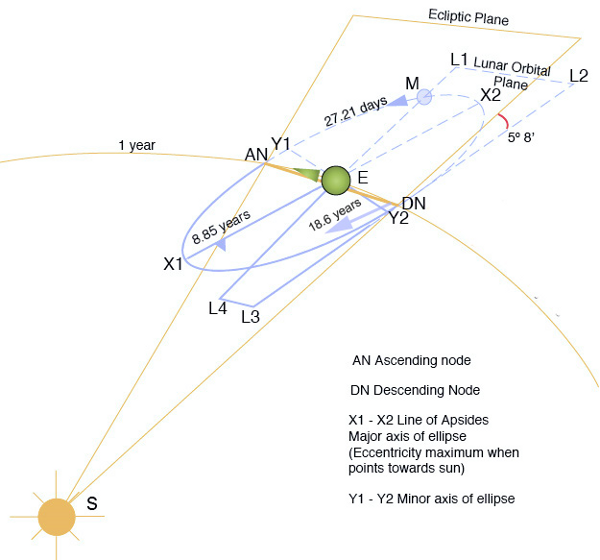
Is there such a thing as a “lunar” Arctic Circle?  The short answer is “yes”, though it is a much more dynamic one than the more familiar solar <a href="http://en.wikipedia.org/wiki/Arctic_circle">Arctic Circle</a>.  Unlike most moons, the orbit of our  Moon is inclined relative to the Earth’s elliptic, the plane of its orbit around the Sun, as opposed to being relative the the Earth’s equator.<sup>1</sup>   The lunar inclination is approximately, 5° 8′.  So, given the tilt of the Earth’s axis, 23° 26′, this puts the lunar Arctic Circle at 90 – (23° 26′ + 5° 8′) or <strong>61° 28′</strong>. Given the right circumstances the Moon would thus be visible due north at that latitude; any further south and it would dip below the horizon.  
</p>
<div class="figure">
<a href="http://en.wikipedia.org/wiki/Orbit_of_the_Moon">
<img src="http://www.xefer.com/image/moon.orbit.png"/>
</a>
<p>Orbital Dynamics of the Moon (via Wikipedia)</p>
</div>
<p>
This however is only the maximum southern limit of the lunar Arctic Circle; it does not account for the procession of the Moon’s orbit around the Earth itself. The points where the moon crosses the elliptic process counterclockwise around the Earth every 18.6 years. (See the points labelled "ascending node" and "descending node" in the diagram above.) This means that the lunar Arctic Circle oscillates &#177;5° 8′ relative the solar Arctic Circle over that period.  Once every period the point of maximum deflection of the Moon’s orbit above the elliptic is in line with the Earth's axis; 9.3 years later it is out of phase and thus, 5° 8′ below the elliptic making the latitude at which it would be visible due north that much higher.  
</p>
<p>
So, while the limit of the lunar Arctic Circle is 61° 28′, it only reaches that latitude once every 18.6 years. 
</p>
<p>
<sup>1</sup> This is in fact one piece of evidence that the Moon was formed by an impact of Earth by a Mars-sized planetoid early in the formation of the Solar System.  If the Earth and Moon were formed at the same time, the Moon’s orbit would most likely be along the axis of the Earth’s rotation, while a planetoid, orbiting on the elliptic with the Earth would have ejected material into the elliptical plane upon impact.
</p>
]]>
      </content>
    </entry>


    <entry>
      <title>Everyone Loves a Banker</title>
      <link rel="alternate" type="text/html" href="http://www.xefer.com/iuncturae/2011/09/260" />
      <id>tag:www.xefer.com,2011:/iuncturae//3.260</id>
      <published>2011-09-12T13:17:32Z</published>
      <updated>2013-10-07T17:52:42Z</updated>
      <summary type="html"> &quot;A priest refused to bury the body of a usurer, one of his parishioners, who had died without making restitution. Since the dead usurer&apos;s friends were very insistent, the priest yielded to their pressure and said, &apos;Let us put...</summary>
      <author>
          <name>Jeffrey</name>
          
      </author>
      
      <content type="html" xml:lang="en" xml:base="http://www.xefer.com/iuncturae/">
          <![CDATA[<p>
"A priest refused to bury the body of a usurer, one of his parishioners, who had died without making restitution. Since the dead usurer's friends were very insistent, the priest yielded to their pressure and said, 'Let us put his body on a donkey and see God's will, and what He will do with the body.  Wherever the donkey takes it, be it a church, a cemetery, or elsewhere, there will I bury it.' The body was placed upon the donkey which without deviating either to the right or left, took it straight out of town to the place where thieves are hanged from the gibbet, and with a hearty buck, sent the cadaver flying into the dung beneath the gallows."  - <a href="http://en.wikipedia.org/wiki/Jacques_de_Vitry">Jacques de Vitry</a>, <a href="http://books.google.com/books?id=rIUTAAAAYAAJ&pg=PA206#v=onepage&q&f=false">Exempla 177</a>, ca. 1215.
</p>
<p>
An anecdote from <a href="http://en.wikipedia.org/wiki/David_Graeber">David Graeber</a>'s new book "<a href="http://amazon.com/o/asin/1933633867/10030-20">Debt: The First 5,000 Years</a>"
</p>]]>
      </content>
    </entry>


    <entry>
      <title>All Roads Lead to &quot;Philosophy&quot;</title>
      <link rel="alternate" type="text/html" href="https://xefer.com/2011/05/wikipedia" />
      <id>tag:www.xefer.com,2011://2.259</id>
      <published>2011-06-01T00:25:38Z</published>
      <updated>2012-11-07T17:58:53Z</updated>
      <summary type="html"> There was an idea floating around that continuously following the first link of any Wikipedia article will eventually lead to &quot;Philosophy.&quot; 1 This sounded like a reasonable assertion, one that makes a certain amount of sense in retrospect: any...</summary>
      <author>
          <name>Jeffrey</name>
          
      </author>
      
      <content type="html" xml:lang="en" xml:base="https://xefer.com/">
          <![CDATA[<p>
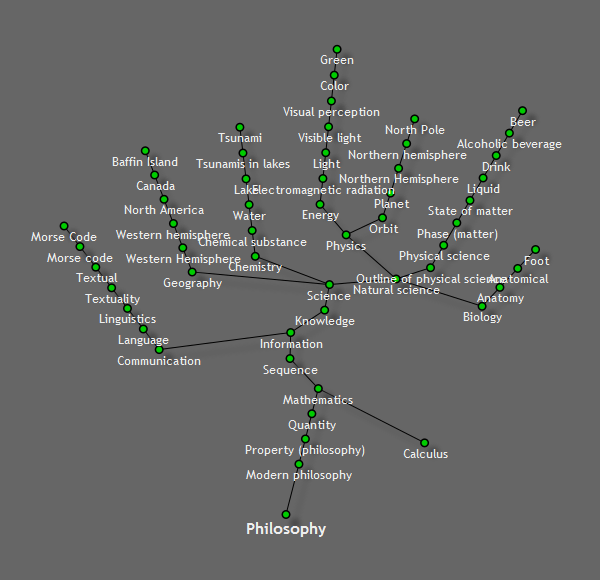
There was an idea floating around that continuously following the first link of any Wikipedia article will eventually lead to "Philosophy." <sup id="wiki-1"><a href="#fn-wiki-1">1</a></sup>  This sounded like a reasonable assertion, one that makes a certain amount of sense in retrospect: any description of something will typically use more general terms.  Following that idea will eventually lead... somewhere.
</p>
<p>
It also sounded like an idea that would be easily examinable with basic client-side scripting tools, using the Wikipedia API and a good graphing package.   I put something together <a href="/wikipedia">here</a> based on <a href="http://jquery.com/">JQuery</a> and the <a href="http://thejit.org/">JavaScript InfoViz Toolkit</a>.  It makes use of the HTML5 &lt;canvas&gt; element, so support for Internet Explorer is provided by the Google <a href="http://excanvas.sourceforge.net/">excanvas</a> package.  
</p>
<div class="figure">
<a href="/wikipedia">
<img src="/image/wikipedia.png"/>
</a>
</div>
<p>
I still have a lot of tweaking to do but the results so far are pretty nice.
</p>
<p>
Multiple titles can be added using a comma-separated list.  JSONP requests are made to Wikipedia asynchronously, so more terms can be added while it is accumulating results.
</p>
<p>
There are some circumstances where a loop is detected up the chain. This is relatively rare.  If it finds that it moves to the next link in the chain.  One good example is "Telecommunication".
</p>
<p>
<sup id="fn-wiki-1"><a href="#wiki-1">1</a></sup> See the tooltip by hovering over the cartoon at <a href="http://xkcd.com/903/">xkcd</a> which is <a href="http://en.wikipedia.org/wiki/Wikipedia:Get_to_Philosophy">said</a> to be the source of this observation.  Though <a href="http://www.reddit.com/r/pics/comments/gpdhb/try_thiswikipedia_mindfk/">this posting</a> on reddit.com appears to predate that by about a month.
</p>]]>
      </content>
    </entry>


    <entry>
      <title>Evolution of the Human Head</title>
      <link rel="alternate" type="text/html" href="https://xefer.com/2011/05/head" />
      <id>tag:www.xefer.com,2011://2.258</id>
      <published>2011-05-15T20:07:50Z</published>
      <updated>2014-02-28T17:28:54Z</updated>
      <summary type="html"> While the title of this book focuses on the evolution of the head, it is much more than that. The first half lays the groundwork with discussions of embryonic development, descriptions of the inter-related systems that make up the...</summary>
      <author>
          <name>Jeffrey</name>
          
      </author>
      
      <content type="html" xml:lang="en" xml:base="https://xefer.com/">
          <![CDATA[<div class="basicimg">
<a href="http://www.amazon.com/exec/obidos/ASIN/0674046366/10030-20">
<img title="The Evolution of the Human Head" alt="The Evolution of the Human Head" src="http://images.amazon.com/images/P/0674046366.02._SCMZZZZZZZ_.jpg">
</a>
</div>
<p>
While the title of this book focuses on the evolution of the head, it is much more than  that.  The first half  lays the groundwork with discussions of embryonic development, descriptions of the inter-related systems that make up the head and methods of comparative biology.
</p>
<p>
This initial survey has a lot of interesting material itself; for example, studies of the teeth and jaw have revealed that most orthodontic problems such as teeth crowding and over-bites, etc., appear to be due to the softer foods of the modern diet.  Several hundred years ago impacted wisdom teeth were relatively rare.  Softer foods result in less bone mass in the jaw and subsequently less room for the full set of adult teeth.
</p>
<p>
A description of the deeply interrelated workings of the inner ear and the visual system leads to a discussion of how balance and visual acuity is maintained during movement, especially running.  The author, <a href="http://harvardmagazine.com/2011/01/head-to-toe">Daniel Lieberman</a> is in fact a proponent of the relatively recent <a href="http://harvardmagazine.com/updates/lieberman-barefoot-running-shoes">barefoot running</a> phenomenon in large part due what the evolution of the head reveals about the body as a complete system.
</p>
<p>
It's a dense book, which even the author says is not meant to be a best seller, but still rewarding.
</p>]]>
      </content>
    </entry>


    <entry>
      <title>Poor Little Rich Girl</title>
      <link rel="alternate" type="text/html" href="https://xefer.com/2011/05/louisa-fletcher" />
      <id>tag:www.xefer.com,2011://2.257</id>
      <published>2011-05-08T18:20:38Z</published>
      <updated>2011-05-09T15:59:40Z</updated>
      <summary type="html"> I came across this now-forgotten story in the New York Times achieves recently. It has some personal interest mostly because of its brief intersection with my home town: BANKER&apos;S DAUGHTER FLEES IN OVERALLS Fisherman Says She Cut Hair BOSTON,...</summary>
      <author>
          <name>Jeffrey</name>
          
      </author>
      
      <content type="html" xml:lang="en" xml:base="https://xefer.com/">
          <![CDATA[<p>
I came across this now-forgotten story in the New York Times achieves recently.  It has some personal interest mostly because of its brief intersection with my home town:
</p>
<blockquote>
<p><span style="center"><a href="http://query.nytimes.com/mem/archive-free/pdf?_r=1&res=9E01E0D61E3CEE3ABC4952DFBF66838B639EDE">BANKER'S DAUGHTER FLEES IN OVERALLS</a></span></p>
<p><span style="center">Fisherman Says She Cut Hair</span></p>
<p>
BOSTON, Sept. 10.&mdash;Miss Louisa A. Fletcher, the 17-year-old daughter and heiress of Stoughton A. Fletcher, a banker, manufacturer and horse breeder of Indianapolis, has vanished from the Summer home recently occupied by her parents at East Gloucester.  She is said to have been seen just before she disappeared clad in a pair of overalls and with her hair clipped short.
</p>
</blockquote>
<blockquote>
<p>
<span style="center"><a href="http://news.google.com/newspapers?id=jrtiAAAAIBAJ&sjid=engNAAAAIBAJ&pg=3127,915495 ">HEIRESS CLIPS HAIR, DONS MALE GARB AND FLEES</a></span>
</p>
<p>
Gloucester. Sept. 11. - Clad in a pair of carpenter's overalls and with her hair cut short like a man's, 17-year-0ld Louisa Fletcher, daughter of Stoughton A. Fletcher, millionaire banker, manufacturer and horse breeder of Indianapolis, rowed away from Rocky Neck shore shortly after noon Thursday and no trace of her has been discovered despite constant searching since.
</p>
</blockquote>
<p>
She wasn't on the lam very long, discovered only two days later "working as a boy" at Upland Farms in Ipswich, Mass., where she had been hired on as a farm hand.  When approached by the police she gave the name "Willie Sullivan" and at first resisted being taken into custody.  A Pittsburgh paper pointed out "<a href="http://news.google.com/newspapers?id=8BwbAAAAIBAJ&sjid=pkkEAAAAIBAJ&pg=3914,3455154">SHE WAS SMOKING CIGARETTES</a>." which perhaps added to the sensation of the story at the time.
</p>
<p>
(Upland Farms is now long gone, but was off Fellows Lane, though a trace of it is left in the name of Upland Road.)
</p>
<p>
She had rowed the dory she stole from Gloucester up the Essex River to Rowley where she spent the next two nights in a barn, eating apples for food.  She made her way to Ipswich and tried to sign onto a fishing boat but was turned away. She was reported to have said, "I was tired of being a '<a href="http://query.nytimes.com/mem/archive-free/pdf?res=F00A16FC3C5E10728DDDAB0994D1405B808EF1D3">poor little rich girl</a>'  I have had too much discipline.  I wanted to make my own way in the world."
</p>
<p>
There is some hint that perhaps she was looking to earn enough money to head to New York City.  The owner of the house they had rented in Gloucester was owned by Langdon Gillette who had worked on Broadway.
</p>
<p>
Louisa Fletcher and her family appeared in newspaper archives again several times over the years.  Her life ended up being short and tragic:
</p>
<p>
In March, 1921, her mother (and her mother's mother) both <a href="http://select.nytimes.com/gst/abstract.html?res=F20916F6385B1B7A93C6AB1788D85F458285F9">committed suicide</a>.
</p>
<p>
By 1924, the family empire was in ruins and her father was forced to declare bankruptcy.
</p>
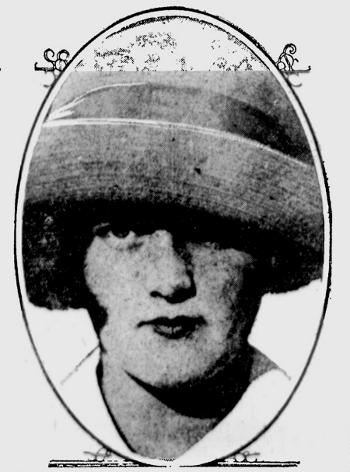
<div class="figure"><img src="/image/fletcher.png"/><p>Miss Louisa Fletcher, 1925</p></div>
<p>
In 1925 she declared her engagement to a Count Ernst Gottfried von Schmettow of Prussia, but upon her arrival in Berlin was rejected by the Count's father and returned home in some shame to New York. The whole incident is shrouded in mystery as it seems that the Count may have been leading her on or she misinterpreted his intentions from the outset.  She may have been trying to use her marriage to European nobility as a vehicle for her own career. 
</p>
<p>
In January, 1927 she was <a href="http://news.google.com/newspapers?id=OLtGAAAAIBAJ&sjid=GXsMAAAAIBAJ&pg=4875,824511">arrested</a> in Los Angeles after an altercation with a "Lady Diana Bathurst".  This "Lady Diana" was apparently a fraud who was trying to use her supposed ties to nobility for her own fame.  This puts Louisa Fletcher's account of her engagement to the Prussian count in to a different light.
</p>
<p>
She <a href="http://news.google.com/newspapers?id=ngUjAAAAIBAJ&sjid=-ssFAAAAIBAJ&pg=6089,4538204">died</a> July 18, 1927 in Los Angeles, reportedly of meningitis, aged 24.
</p>
<p>
Her brother, <a href="http://www.tyleralpern.com/bruz.html">Stoughton A. "Bruz" Fletcher III</a>, who had accompanied her to LA and became a staple on the "<a href="http://en.wikipedia.org/wiki/Pansy_Craze#Bruz_Fletcher">Pansy Craze</a>" scene, committed suicide in 1941.
</p>]]>
      </content>
    </entry>
  
</feed>